


- Afhalen na 1 uur in een winkel met voorraad
- Gratis thuislevering in België vanaf € 30
- Ruim aanbod met 7 miljoen producten
- Afhalen na 1 uur in een winkel met voorraad
- Gratis thuislevering in België vanaf € 30
- Ruim aanbod met 7 miljoen producten





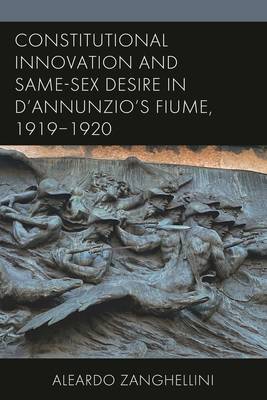
Constitutional Innovation and Same-Sex Desire in d'Annunzio's Fiume, 1919-1920
Aleardo Zanghellini
€ 221,45
+ 442 punten
Omschrijving
Drawing on novel archival evidence that sheds light on Anglo-Italian diplomatic relations and the French-Italian contest for power in the Adriatic, this book recounts the story of decadent poet Gabriele D'Annunzio's occupation of Fiume. Determining the fate of this Italian enclave in coastal Croatia had proved impossible at the Paris Peace Conference. In September 1919, D'Annunzio and his 'legionnaires' installed themselves in Fiume in a bid to embarrass Italy into declaring its annexation. In the months that followed, the poet did his best to fashion Fiume into his ideal political community, culminating in the proclamation of a Constitution known as the Carnaro Charter. The Charter was as visionary as it was short-lived: having reached an agreement with Yugoslavia on the status of Fiume, Italy put an end to the poet's socio-political experiment in December 1920. In addition to offering the most comprehensive and detailed analysis to date of the Carnaro Charter, the book shows what has eluded all historians of D'Annunzio's Fiume: that the sublimation and discursive circulation of same-sex desire was integral to shaping and sustaining the political and legal order of the occupation, and that D'Annunzio's love-lore in Fiume was continuous with broader homoerotic preoccupations in his oeuvre.
Specificaties
Betrokkenen
- Auteur(s):
- Uitgeverij:
Inhoud
- Aantal bladzijden:
- 494
- Taal:
- Engels
- Reeks:
Eigenschappen
- Productcode (EAN):
- 9781683934356
- Verschijningsdatum:
- 15/12/2024
- Uitvoering:
- Hardcover
- Formaat:
- Genaaid
- Afmetingen:
- 152 mm x 229 mm
- Gewicht:
- 775 g


Alleen bij Standaard Boekhandel
+ 442 punten op je klantenkaart van Standaard Boekhandel
Cadeau

AANGERADEN


Beoordelingen
We publiceren alleen reviews die voldoen aan de voorwaarden voor reviews. Bekijk onze voorwaarden voor reviews.