


- Afhalen na 1 uur in een winkel met voorraad
- Gratis thuislevering in België vanaf € 30
- Ruim aanbod met 7 miljoen producten
- Afhalen na 1 uur in een winkel met voorraad
- Gratis thuislevering in België vanaf € 30
- Ruim aanbod met 7 miljoen producten




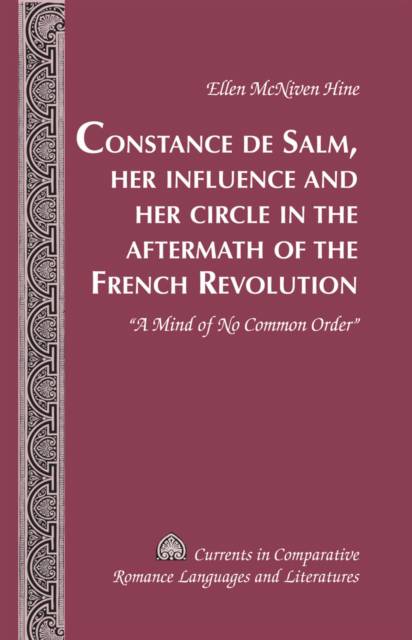
Constance de Salm, Her Influence and Her Circle in the Aftermath of the French Revolution
«A Mind of No Common Order»
Ellen McNiven Hine
€ 171,45
+ 342 punten
Omschrijving
Largely forgotten during the second half of the nineteenth century and throughout most of the twentieth century, Constance de Salm (Constance-Marie de Théis, Mme Pipelet de Leury, later Princess de Salm-Reifferscheid-Dyck, ) finally attracted the attention of such scholars as Elizabeth Colwill, Geneviève Fraisse, Huguette Krief, and Christine Planté in the early twenty-first century. However, there has to date been no comprehensive study of her published works, her vast correspondence, and the importance of her cultural exchanges. In this book, Ellen McNiven Hine contributes to the recent upsurge of interest in the literature of this particularly turbulent period in French history. This book considers not only her literary aspirations and claim to fame but also such topics as her contribution to the scientific culture of the period, the extent of the political involvement of a non-activist woman, her challenge to what she saw as inequitable provisions in the Civil Code, her championing of women's progress in literature and the arts, and the role that networking and patronage played in her personal and professional life. Moreover, the study highlights the similarities and differences between her life, writing, and influence and those of other postrevolutionary women such as Mary Wollstonecraft, Germaine de Staël, Margaret Somerville, and Louise Colet.
Constance de Salm uses a variety of genres to address issues of particular importance to women, such as equal access to educational opportunities, the cost to women's health of reproduction, and lack of economic resources for single and widowed women. She displays a surprising modernity in her awareness of the difficulty of resolving relationship, career, and motherhood problems that continue to plague women in the twenty-first century and points to a future in which women will have access to educational and employment opportunities.
Constance de Salm uses a variety of genres to address issues of particular importance to women, such as equal access to educational opportunities, the cost to women's health of reproduction, and lack of economic resources for single and widowed women. She displays a surprising modernity in her awareness of the difficulty of resolving relationship, career, and motherhood problems that continue to plague women in the twenty-first century and points to a future in which women will have access to educational and employment opportunities.
Specificaties
Betrokkenen
- Auteur(s):
- Uitgeverij:
Inhoud
- Aantal bladzijden:
- 257
- Taal:
- Engels
- Reeks:
- Reeksnummer:
- nr. 193
Eigenschappen
- Productcode (EAN):
- 9781433114298
- Verschijningsdatum:
- 28/12/2011
- Uitvoering:
- Hardcover
- Formaat:
- Genaaid
- Afmetingen:
- 150 mm x 226 mm
- Gewicht:
- 476 g


Alleen bij Standaard Boekhandel
+ 342 punten op je klantenkaart van Standaard Boekhandel
AANGERADEN


Beoordelingen
We publiceren alleen reviews die voldoen aan de voorwaarden voor reviews. Bekijk onze voorwaarden voor reviews.