


- Afhalen na 1 uur in een winkel met voorraad
- Gratis thuislevering in België vanaf € 30
- Ruim aanbod met 7 miljoen producten
- Afhalen na 1 uur in een winkel met voorraad
- Gratis thuislevering in België vanaf € 30
- Ruim aanbod met 7 miljoen producten





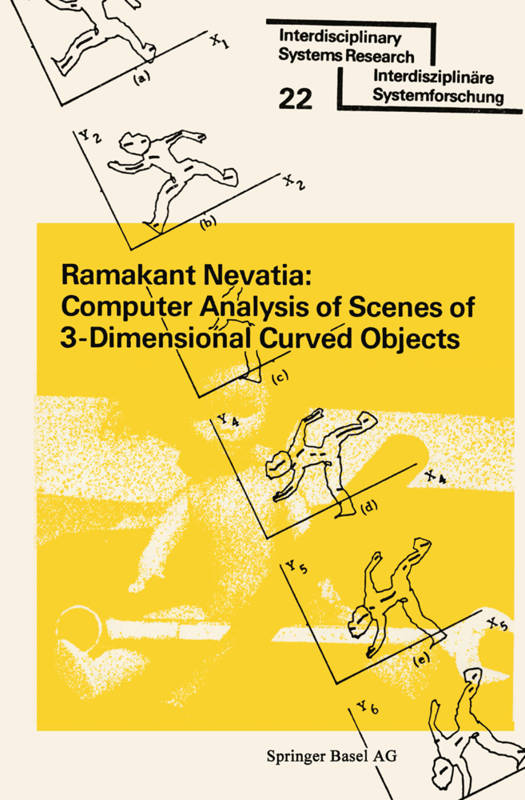
Computer Analysis of Scenes of 3-Dimensional Curved Objects
Nevatia
€ 53,45
+ 106 punten
Omschrijving
1.0 2 The attention then turned to the problem of "Body separation", i.e. separation of occluding bodies in a scene (See [Guzman), [Falk), and [Waltz)). Grape ([Grape)) combined the separation of bodies with recognition, by removing parts of the scene recognized as belonging to a known body. All of these techniques were designed to work with polyhedral objects only, and extensively use the properties of edges and vertices. Though some impressive results have been reported ([Waltz], [Grape)), and perhaps some useful abstractions can be made, the specific techniques used fail to generalize to a wider class of objects. Among previous work on curved objects, B.K.P. Horn ([Horn)) presented techniques for extracting three dimensional depth data from a TV image, using reflection characteristics of the surface. Krakauer ([Krakauer]) represented objects by connections of brightness contours. Ambler et al ([Ambler)) describe experiments with simple shapes, including curved objects, using relations within a two-dimensional image. However, none of these efforts really addresses the problem of "shape" representation and description. Work on outdoor scene analysis is also concerned with non-polyhedral objects ([Bajcsy], [Yakimovsky]), but again no attention has been paid to shape analysis.
Specificaties
Betrokkenen
- Auteur(s):
- Uitgeverij:
Inhoud
- Aantal bladzijden:
- 125
- Taal:
- Engels
- Reeks:
Eigenschappen
- Productcode (EAN):
- 9783764308452
- Verschijningsdatum:
- 1/01/1976
- Uitvoering:
- Paperback
- Formaat:
- Trade paperback (VS)
- Afmetingen:
- 156 mm x 234 mm
- Gewicht:
- 204 g


Alleen bij Standaard Boekhandel
+ 106 punten op je klantenkaart van Standaard Boekhandel
CADEAU

AANGERADEN


Beoordelingen
We publiceren alleen reviews die voldoen aan de voorwaarden voor reviews. Bekijk onze voorwaarden voor reviews.