



Je cadeautjes zeker op tijd in huis hebben voor de feestdagen? Kom langs in onze winkels en vind het perfecte geschenk!
- Afhalen na 1 uur in een winkel met voorraad
- Gratis thuislevering in België vanaf € 30
- Ruim aanbod met 7 miljoen producten
Je cadeautjes zeker op tijd in huis hebben voor de feestdagen? Kom langs in onze winkels en vind het perfecte geschenk!
- Afhalen na 1 uur in een winkel met voorraad
- Gratis thuislevering in België vanaf € 30
- Ruim aanbod met 7 miljoen producten





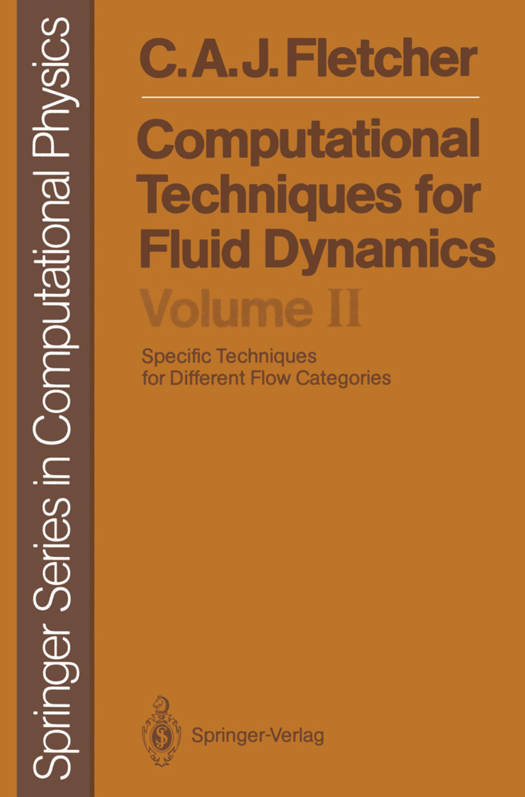
Computational Techniques for Fluid Dynamics
Specific Techniques for Different Flow Categories
Clive A J Fletcher
€ 79,19
+ 158 punten
Omschrijving
As indicated in Vol. 1, the purpose of this two-volume textbook is to pro- vide students of engineering, science and applied mathematics with the spe- cific techniques, and the framework to develop skill in using them, that have proven effective in the various branches of computational fluid dy- namics Volume 1 describes both fundamental and general techniques that are relevant to all branches of fluid flow. This volume contains specific tech- niques applicable to the different categories of engineering flow behaviour, many of which are also appropriate to convective heat transfer. The contents of Vol. 2 are suitable for specialised graduate courses in the engineering computational fluid dynamics (CFD) area and are also aimed at the established research worker or practitioner who has already gained some fundamental CFD background. It is assumed that the reader is famil- iar with the contents of Vol. 1. The contents of Vol. 2 are arranged in the following way: Chapter 11 de- velops and discusses the equations governing fluid flow and introduces the simpler flow categories for which specific computational techniques are considered in Chaps. 14-18. Most practical problems involve computational domain boundaries that do not conveniently coincide with coordinate lines. Consequently, in Chap. 12 the governing equations are expressed in generalised curvilinear coordinates for use in arbitrary computational domains. The corresponding problem of generating an interior grid is considered in Chap. 13.
Specificaties
Betrokkenen
- Auteur(s):
- Uitgeverij:
Inhoud
- Aantal bladzijden:
- 484
- Taal:
- Engels
- Reeks:
Eigenschappen
- Productcode (EAN):
- 9783642970733
- Verschijningsdatum:
- 9/01/2012
- Uitvoering:
- Paperback
- Formaat:
- Trade paperback (VS)
- Afmetingen:
- 156 mm x 234 mm
- Gewicht:
- 693 g



Alleen bij Standaard Boekhandel
+ 158 punten op je klantenkaart van Standaard Boekhandel
CADEAU


Beoordelingen
We publiceren alleen reviews die voldoen aan de voorwaarden voor reviews. Bekijk onze voorwaarden voor reviews.