


- Afhalen na 1 uur in een winkel met voorraad
- Gratis thuislevering in België vanaf € 30
- Ruim aanbod met 7 miljoen producten
- Afhalen na 1 uur in een winkel met voorraad
- Gratis thuislevering in België vanaf € 30
- Ruim aanbod met 7 miljoen producten





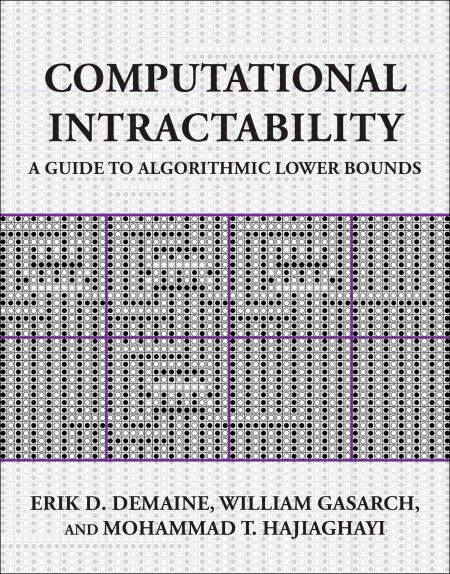
Computational Intractability E-BOOK
A Guide to Algorithmic Lower Bounds
Erik D. Demaine, William Gasarch, Mohammad T. Hajiaghayi
E-book | Engels
€ 88,71
+ 88 punten
Uitvoering
Omschrijving
A practical guide to understanding the theory and practice of computational lower bounds.
A fundamental question in computer science is: “Given a problem, how hard is it to solve?” Usually, the answer to this question lies in determining how long it will take to solve a problem as a function of the length of the input. Yet this question has two different parts, with two different answers: (1) upper bounds, which show that a problem can be solved in time T(n), and (2) lower bounds, which show that a problem cannot be solved in time T(n). In Computational Intractability, Erik Demaine, William Gasarch, and Mohammad Hajiaghayi focus on the latter, providing a guidebook to navigating lower bounds via the study of P, NP, NP-completeness, and other related notions.
Computational Intractability covers virtually all aspects of lower bounds, from parallelism to undecidability, and explores this material from the point of view of actual problems rather than classes of problems. The authors show how to prove lower bounds on problems in a wide variety of settings: polynomial time, classes likely above polynomial time (e.g., polynomial space), and classes within polynomial time (e.g., quadratic time).
A fundamental question in computer science is: “Given a problem, how hard is it to solve?” Usually, the answer to this question lies in determining how long it will take to solve a problem as a function of the length of the input. Yet this question has two different parts, with two different answers: (1) upper bounds, which show that a problem can be solved in time T(n), and (2) lower bounds, which show that a problem cannot be solved in time T(n). In Computational Intractability, Erik Demaine, William Gasarch, and Mohammad Hajiaghayi focus on the latter, providing a guidebook to navigating lower bounds via the study of P, NP, NP-completeness, and other related notions.
Computational Intractability covers virtually all aspects of lower bounds, from parallelism to undecidability, and explores this material from the point of view of actual problems rather than classes of problems. The authors show how to prove lower bounds on problems in a wide variety of settings: polynomial time, classes likely above polynomial time (e.g., polynomial space), and classes within polynomial time (e.g., quadratic time).
Specificaties
Betrokkenen
- Auteur(s):
- Uitgeverij:
Inhoud
- Aantal bladzijden:
- 550
- Taal:
- Engels
Eigenschappen
- Productcode (EAN):
- 9780262381147
- Verschijningsdatum:
- 21/09/2026
- Uitvoering:
- E-book
- Beveiligd met:
- Adobe DRM
- Formaat:
- ePub


Alleen bij Standaard Boekhandel
+ 88 punten op je klantenkaart van Standaard Boekhandel
Cadeau

AANGERADEN


Beoordelingen
We publiceren alleen reviews die voldoen aan de voorwaarden voor reviews. Bekijk onze voorwaarden voor reviews.