


- Afhalen na 1 uur in een winkel met voorraad
- Gratis thuislevering in België vanaf € 30
- Ruim aanbod met 7 miljoen producten
- Afhalen na 1 uur in een winkel met voorraad
- Gratis thuislevering in België vanaf € 30
- Ruim aanbod met 7 miljoen producten





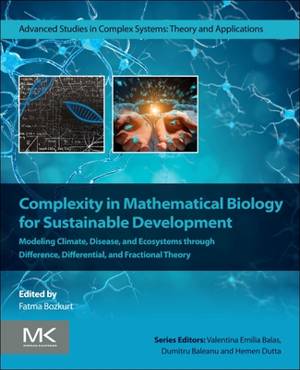
Complexity in Mathematical Biology for Sustainable Development
Modeling Climate, Disease, and Ecosystems Through Difference, Differential, and Fractional Theory
Fatma Bozkurt
€ 259,45
+ 518 punten
Omschrijving
Complexity in Mathematical Biology for Sustainable Development: Modeling Climate, Disease, and Ecosystems through Difference, Differential, and Fractional Theory introduces new mathematical methods to derive complex modeling solutions for a wide range of engineering and scientific research applications. The book strikes a balance between high-level mathematical theory and technical derivations, offering step-by-step explanations, real-world case studies, and clear introductions to advanced mathematical models. Solutions include modeling and quantifying complexity, with emphasis placed on the growing need for interdisciplinary collaboration, the integration of real-time data into models, and the development of adaptive frameworks challenges such as pandemics, biodiversity loss, and climate uncertainty. The book is designed to meet the needs of a diverse primary audience, from graduate students to professionals in fields such as computer science, public health, environmental policy, applied mathematics, and biotechnology. By providing both theoretical foundations and practical applications, the book equips readers with the skills and knowledge to tackle pressing global challenges through mathematical models, making it a valuable resource for both academic and professional development.
Specificaties
Betrokkenen
- Auteur(s):
- Uitgeverij:
Inhoud
- Aantal bladzijden:
- 250
- Taal:
- Engels
- Reeks:
Eigenschappen
- Productcode (EAN):
- 9780443452963
- Verschijningsdatum:
- 1/08/2026
- Uitvoering:
- Paperback
- Formaat:
- Trade paperback (VS)
- Afmetingen:
- 190 mm x 235 mm
- Gewicht:
- 449 g


Alleen bij Standaard Boekhandel
+ 518 punten op je klantenkaart van Standaard Boekhandel
Cadeau

AANGERADEN


Beoordelingen
We publiceren alleen reviews die voldoen aan de voorwaarden voor reviews. Bekijk onze voorwaarden voor reviews.