


- Afhalen na 1 uur in een winkel met voorraad
- Gratis thuislevering in België vanaf € 30
- Ruim aanbod met 7 miljoen producten
- Afhalen na 1 uur in een winkel met voorraad
- Gratis thuislevering in België vanaf € 30
- Ruim aanbod met 7 miljoen producten





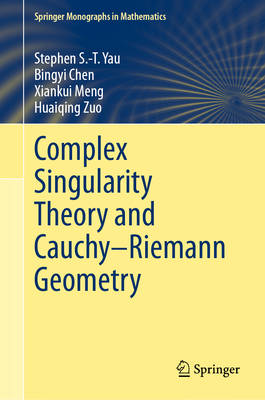
Complex Singularity Theory and Cauchy-Riemann Geometry
Stephen S -T Yau, Bingyi Chen, Xiankui Meng, Huaiqing Zuo
€ 162,45
+ 324 punten
Omschrijving
This book presents a rigorous, self-contained, and systematic study of Cauchy-Riemann (CR) manifolds and their deep connections to singularity theory. It synthesizes foundational contributions to CR geometry and complex singularity theory, including the solution of the complex Plateau problem and the Mather-Yau theorem, which links complex geometry with finite-dimensional commutative algebras and the Bergman function theory developed by Stephen S.-T. Yau. The discussion brings together techniques from differential geometry, several complex variables, and singularity theory within a unified framework. Complete proofs enhance the book's value as an authoritative reference, while the concise exposition facilitates access to advanced material. Readers are expected to have a solid background in several complex variables and some familiarity with normal isolated singularities and covering spaces. The book will be of interest to a broad audience of graduate students and researchers working in the areas and topics it addresses, and much of the material may also serve as the basis for graduate-level courses.
Chapter 1 reviews the basic theory of CR geometry, including the Levi form, CR-holomorphic vector bundles, Kohn-Rossi cohomology, Hodge theory on CR manifolds, and a proof of the Boutet de Monvel theorem on the global embedding of CR manifolds. Chapter 2 covers singularities, including resolution of singularities and the geometric genus. Chapter 3 describes the relationship between CR invariants of strongly pseudoconvex manifolds and the invariants of interior normal isolated singularities of varieties bounded by such manifolds. Chapter 4 studies the rigidity of CR morphisms using techniques from singularity theory. The final chapter presents the Bergman function theory developed by Stephen S.-T. Yau, which is used to construct explicitly infinite-dimensional moduli spaces of certain CR manifolds.
Specificaties
Betrokkenen
- Auteur(s):
- Uitgeverij:
Inhoud
- Aantal bladzijden:
- 183
- Taal:
- Engels
- Reeks:
Eigenschappen
- Productcode (EAN):
- 9783032246592
- Verschijningsdatum:
- 13/07/2026
- Uitvoering:
- Hardcover
- Formaat:
- Genaaid
- Afmetingen:
- 155 mm x 235 mm


Alleen bij Standaard Boekhandel
+ 324 punten op je klantenkaart van Standaard Boekhandel
CADEAU

AANGERADEN


Beoordelingen
We publiceren alleen reviews die voldoen aan de voorwaarden voor reviews. Bekijk onze voorwaarden voor reviews.