


- Afhalen na 1 uur in een winkel met voorraad
- Gratis thuislevering in België vanaf € 30
- Ruim aanbod met 7 miljoen producten
- Afhalen na 1 uur in een winkel met voorraad
- Gratis thuislevering in België vanaf € 30
- Ruim aanbod met 7 miljoen producten





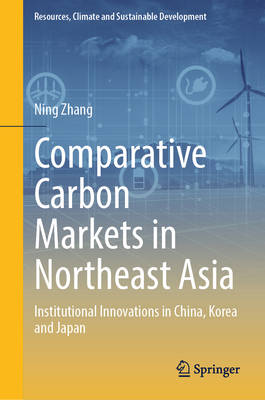
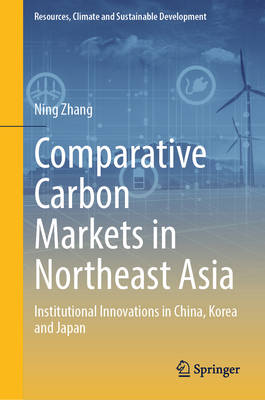
Comparative Carbon Markets in Northeast Asia
Institutional Innovations in China, Korea and Japan
Ning Zhang
€ 181,95
+ 363 punten
Omschrijving
This book offers a comprehensive framework for comparing Northeast Asia's market-based climate and energy policies, integrating carbon market theories, empirical data from China, South Korea, Japan, and practical policy cases. It bridges theory and regional practice, analyzing how the three nations--at distinct development stages--design tools to balance emission cuts, energy security, and economic growth. It covers core mechanisms: China's national ETS (the world's largest, covering 8 billion tons of emissions) and energy use rights trading; South Korea's K-ETS (Asia's first mandatory carbon market) with "auction + free allocation" and price stabilization tools (floor price, market reserve); Japan's GX-ETS featuring central-local dual-track and voluntary-to-mandatory transition. Applying a four-dimensional framework (policy design, economic efficiency, innovation incentives, environmental effectiveness), it quantifies differences in quota allocation, carbon price volatility, green innovation, and emission reduction effects. Special focus is on heavy industries (steel, cement, aluminum), comparing technological routes (China's electric arc furnace steel, South Korea's hydrogen metallurgy, Japan's CCUS) and carbon cost pass-through. This book is a key resource for advanced students in environmental economics/climate policy, and researchers, policymakers, and industry leaders in Northeast Asia's climate governance. Its empirical data (quota tables, carbon price trends, industrial metrics) and policy roadmaps add value, especially for new analysts. Key features: - Links global climate theories to Northeast Asia's policy innovations. - Specialized chapters on heavy industry decarbonization. - Actionable roadmap for regional carbon market linkage (China-South Korea allowance mutual recognition, China-Japan offset alignment). - Data from official sources (China's MEE, South Korea's MOE, Japan's METI). Readers gain theoretical insights into regional policy differences and practical tools for policy design, industrial decarbonization, and regional climate cooperation.
Specificaties
Betrokkenen
- Auteur(s):
- Uitgeverij:
Inhoud
- Aantal bladzijden:
- 302
- Taal:
- Engels
- Reeks:
Eigenschappen
- Productcode (EAN):
- 9789819578313
- Verschijningsdatum:
- 05/05/2026
- Uitvoering:
- Hardcover
- Formaat:
- Genaaid
- Afmetingen:
- 155 mm x 235 mm


Alleen bij Standaard Boekhandel
+ 363 punten op je klantenkaart van Standaard Boekhandel
AANGERADEN


Beoordelingen
We publiceren alleen reviews die voldoen aan de voorwaarden voor reviews. Bekijk onze voorwaarden voor reviews.