Standaard Boekhandel gebruikt cookies en gelijkaardige technologieën om de website goed te laten werken en je een betere surfervaring te bezorgen.
Hieronder kan je kiezen welke cookies je wilt inschakelen:
Technische en functionele cookies
Deze cookies zijn essentieel om de website goed te laten functioneren, en laten je toe om bijvoorbeeld in te loggen. Je kan deze cookies niet uitschakelen.
Analytische cookies
Deze cookies verzamelen anonieme informatie over het gebruik van onze website. Op die manier kunnen we de website beter afstemmen op de behoeften van de gebruikers.
Marketingcookies
Deze cookies delen je gedrag op onze website met externe partijen, zodat je op externe platformen relevantere advertenties van Standaard Boekhandel te zien krijgt.
Bedankt voor het vertrouwen het afgelopen jaar! Om jou te bedanken bieden we GRATIS verzending (in België) aan op alles gedurende de hele maand januari.
Afhalen na 1 uur in een winkel met voorraad
In januari gratis thuislevering in België
Ruim aanbod met 7 miljoen producten
Bedankt voor het vertrouwen het afgelopen jaar! Om jou te bedanken bieden we GRATIS verzending (in België) aan op alles gedurende de hele maand januari.
Je kan maximaal 250 producten tegelijk aan je winkelmandje toevoegen. Verwijdere enkele producten uit je winkelmandje, of splits je bestelling op in meerdere bestellingen.
In januari gratis thuislevering in België (via bpost)
Gratis levering in je Standaard Boekhandel
Omschrijving
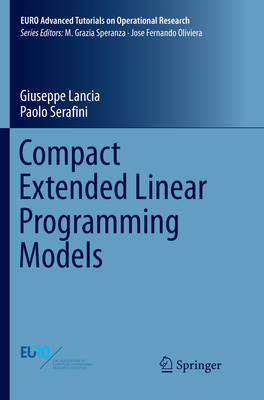
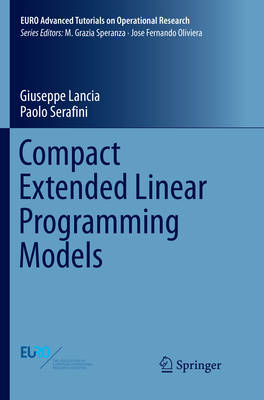
This book provides a handy, unified introduction to the theory of compact extended formulations of exponential-size integer linear programming (ILP) models. Compact extended formulations are equally powerful, but polynomial-sized, models whose solutions do not require the implementation of separation and pricing procedures. The book is written in a general, didactic form, first developing the background theoretical concepts (polyhedra, projections, linear and integer programming) and then delving into the various techniques for compact extended reformulations. The techniques are illustrated through a wealth of examples touching on many application areas, such as classical combinatorial optimization, network design, timetabling, scheduling, routing, computational biology and bioinformatics. The book is intended for graduate or PhD students - either as an advanced course on selected topics or within a more general course on ILP and mathematical programming - as well as for practitionersand software engineers in industry exploring techniques for developing optimization models for their specific problems.