


- Afhalen na 1 uur in een winkel met voorraad
- Gratis thuislevering in België vanaf € 30
- Ruim aanbod met 7 miljoen producten
- Afhalen na 1 uur in een winkel met voorraad
- Gratis thuislevering in België vanaf € 30
- Ruim aanbod met 7 miljoen producten





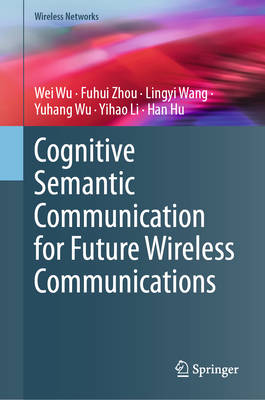
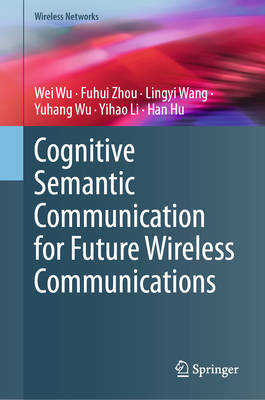
Cognitive Semantic Communication for Future Wireless Communications
Wei Wu, Fuhui Zhou, Lingyi Wang, Yuhang Wu, Yihao Li, Han Hu
€ 305,45
+ 610 punten
Omschrijving
The rapid evolution of 6G networks demands communication systems that go beyond data transmission toward intelligent understanding. Semantic communication (SemCom) represents a paradigm shift from transmitting bits to transmitting meaning. By integrating artificial intelligence, knowledge graphs, and reasoning capabilities, cognitive SemCom further enables networks to infer, interpret, and deliver only task-relevant information, thereby achieving higher efficiency, robustness, and explainability than classical SemCom architectures.
This book provides a comprehensive overview of cognitive SemCom, from fundamental theories to practical implementations. It explores how structured knowledge can be used for semantic encoding, reasoning, compression, and robust signal recovery under interference, model mismatch, and adversarial attacks. Core topics include UAV-enabled cognitive SemCom systems, multi-user and multi-modal resource allocation, and cross-layer semantic security. The book also demonstrates how semantic communication can support low-latency, energy-efficient, and intelligence-native 6G systems.
Designed for researchers, engineers, and graduate students in wireless communications, signal processing, and artificial intelligence, this book bridges communication theory with machine intelligence. Readers will gain a deep understanding of how cognitive abilities transform communication from symbol transmission to meaning exchange, and how these innovations enable future intelligent networks.
Specificaties
Betrokkenen
- Auteur(s):
- Uitgeverij:
Inhoud
- Aantal bladzijden:
- 219
- Taal:
- Engels
- Reeks:
Eigenschappen
- Productcode (EAN):
- 9789819209811
- Verschijningsdatum:
- 24/07/2026
- Uitvoering:
- Hardcover
- Formaat:
- Genaaid
- Afmetingen:
- 155 mm x 235 mm


Alleen bij Standaard Boekhandel
+ 610 punten op je klantenkaart van Standaard Boekhandel
Cadeau

AANGERADEN


Beoordelingen
We publiceren alleen reviews die voldoen aan de voorwaarden voor reviews. Bekijk onze voorwaarden voor reviews.