


- Afhalen na 1 uur in een winkel met voorraad
- Gratis thuislevering in België vanaf € 30
- Ruim aanbod met 7 miljoen producten
- Afhalen na 1 uur in een winkel met voorraad
- Gratis thuislevering in België vanaf € 30
- Ruim aanbod met 7 miljoen producten





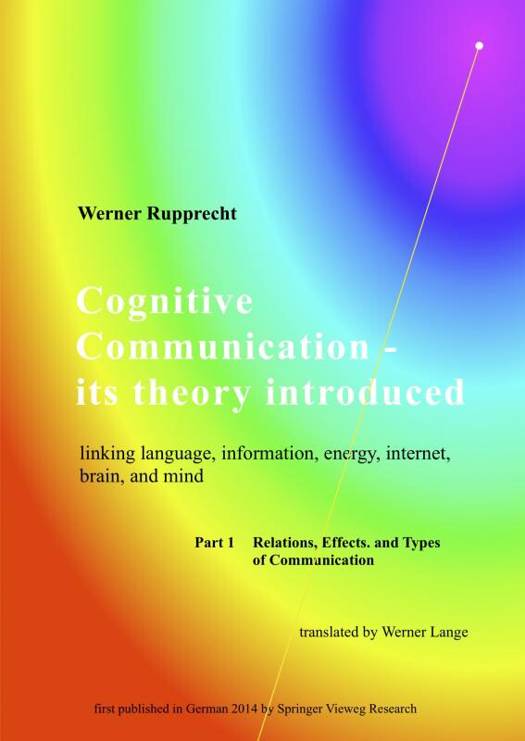
Cognitive Communication - its theory introduced
Part 1 Relations, Effects, and Types of Communication
Werner Rupprecht
Paperback | Engels
€ 16,00
+ 32 punten
Uitvoering
Eenvoudig bestellen
Veilig betalen


Gratis thuislevering vanaf € 30 (via bpost)
Gratis levering in je Standaard Boekhandel
Omschrijving
The function of cognitive communication is to enable people and machines to acquire knowledge. The gain in knowledge lies in the information gained from the signals received. Machine languages and natural languages spoken by people differ in that the signals of machine languages have sharply defined meanings, while the meanings of signals of natural languages are highly fuzzy.
Werner Rupprecht explains how vague meanings arise in the brains of human beings, and that, paradoxically, owing to such vagueness, people are able to gain insights that machines cannot. He explains in detail the links between information theoretical entropy, thermodynamic entropy and energy, describes the sensory organs of humans, the processing of signals in neuronal networks and machines, the development of media, especially the internet, and discusses the role of an immaterial mind.
Werner Rupprecht explains how vague meanings arise in the brains of human beings, and that, paradoxically, owing to such vagueness, people are able to gain insights that machines cannot. He explains in detail the links between information theoretical entropy, thermodynamic entropy and energy, describes the sensory organs of humans, the processing of signals in neuronal networks and machines, the development of media, especially the internet, and discusses the role of an immaterial mind.
Specificaties
Betrokkenen
- Auteur(s):
- Uitgeverij:
Inhoud
- Aantal bladzijden:
- 90
- Taal:
- Engels
Eigenschappen
- Productcode (EAN):
- 9789403613475
- Verschijningsdatum:
- 4/10/2023
- Uitvoering:
- Paperback
- Afmetingen:
- 170 mm x 240 mm
- Gewicht:
- 187 g


Alleen bij Standaard Boekhandel
+ 32 punten op je klantenkaart van Standaard Boekhandel
CADEAU

AANGERADEN


Beoordelingen
We publiceren alleen reviews die voldoen aan de voorwaarden voor reviews. Bekijk onze voorwaarden voor reviews.