


- Afhalen na 1 uur in een winkel met voorraad
- Gratis thuislevering in België vanaf € 30
- Ruim aanbod met 7 miljoen producten
- Afhalen na 1 uur in een winkel met voorraad
- Gratis thuislevering in België vanaf € 30
- Ruim aanbod met 7 miljoen producten





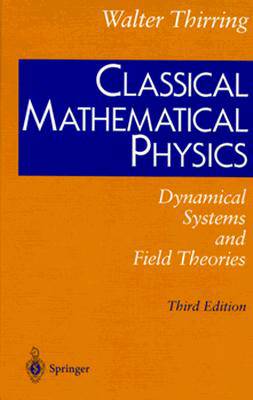
Classical Mathematical Physics
Dynamical Systems and Field Theories
Walter Thirring
Hardcover | Engels
€ 152,95
+ 305 punten
Uitvoering
Eenvoudig bestellen
Veilig betalen


Gratis thuislevering vanaf € 30 (via bpost)
Gratis levering in je Standaard Boekhandel
Omschrijving
I Classical Dynamical Systems.- 1 Introduction.- 1.1 Equations of Motion.- 1.2 The Mathematical Language.- 1.3 The Physical Interpretation.- 2 Analysis on Manifolds.- 2.1 Manifolds.- 2.2 Tangent Spaces.- 2.3 Flows.- 2.4 Tensors.- 2.5 Differentiation.- 2.6 Integrals.- 3 Hamiltonian Systems.- 3.1 Canonical Transformations.- 3.2 Hamilton's Equations.- 3.3 Constants of Motion.- 3.4 The Limit t ? ±?.- 3.5 Perturbation Theory: Preliminaries.- 3.6 Perturbation Theory: The Iteration.- 4 Nonrelativistic Motion.- 4.1 Free Particles.- 4.2 The Two-Body Problem.- 4.3 The Problem of Two Centers of Force.- 4.4 The Restricted Three-Body Problem.- 4.5 The N-Body Problem.- 5 Relativistic Motion.- 5.1 The Hamiltonian Formulation of the Electrodynamic Equations of Motion.- 5.2 The Constant Field.- 5.3 The Coulomb Field.- 5.4 The Betatron.- 5.5 The Traveling Plane Disturbance.- 5.6 Relativistic Motion in a Gravitational Field.- 5.7 Motion in the Schwarzschild Field.- 5.8 Motion in a Gravitational Plane Wave.- 6 The Structure of Space and Time.- 6.1 The Homogeneous Universe.- 6.2 The Isotropic Universe.- 6.3 Me According to Galileo.- 6.4 Me as Minkowski Space.- 6.5 Me as a Pseudo-Riemannian Space.- II Classical Field Theory.- 7 Introduction to Classical Field Theory.- 7.1 Physical Aspects of Field Dynamics.- 7.2 The Mathematical Formalism.- 7.3 Maxwell's and Einstein's Equations.- 8 The Electromagnetic Field of a Known Charge Distribution.- 8.1 The Stationary-Action Principle and Conservation Theorems.- 8.2 The General Solution.- 8.3 The Field of a Point Charge.- 8.4 Radiative Reaction.- 9 The Field in the Presence of Conductors.- 9.1 The Superconductor.- 9.2 The Half-Space, the Wave-Guide, and the Resonant Cavity.- 9.3 Diffraction at a Wedge.- 9.4 Diffraction at a Cylinder.- 10 Gravitation.- 10.1 Covariant Differentiation and the Curvature of Space.- 10.2 Gauge Theories and Gravitation.- 10.3 Maximally Symmetric Spaces.- 10.4 Spaces with Maximally Symmetric Submanifolds.- 10.5 The Life and Death of Stars.- 10.6 The Existence of Singularities.
Specificaties
Betrokkenen
- Auteur(s):
- Vertaler(s):
- Uitgeverij:
Inhoud
- Aantal bladzijden:
- 576
- Taal:
- Engels
Eigenschappen
- Productcode (EAN):
- 9780387948430
- Verschijningsdatum:
- 10/10/1997
- Uitvoering:
- Hardcover
- Formaat:
- Genaaid
- Afmetingen:
- 159 mm x 240 mm
- Gewicht:
- 934 g


Alleen bij Standaard Boekhandel
+ 305 punten op je klantenkaart van Standaard Boekhandel
CADEAU

AANGERADEN


Beoordelingen
We publiceren alleen reviews die voldoen aan de voorwaarden voor reviews. Bekijk onze voorwaarden voor reviews.