


- Afhalen na 1 uur in een winkel met voorraad
- Gratis thuislevering in België vanaf € 30
- Ruim aanbod met 7 miljoen producten
- Afhalen na 1 uur in een winkel met voorraad
- Gratis thuislevering in België vanaf € 30
- Ruim aanbod met 7 miljoen producten




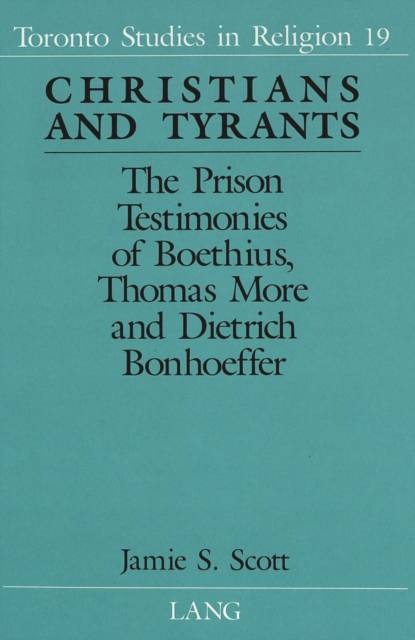
Christians and Tyrants
The Prison Testimonies of Boethius, Thomas More and Dietrich Bonhoeffer
Jamie S Scott
€ 60,45
+ 120 punten
Omschrijving
Conflict between religion and politics often results in a paradigm shift in cultural history. In turn, such paradigm shifts in the history of religion invariably produce martyrs. As Christianity moves from the classical to the medieval world, from the medieval to the modern, and from the modern to the postmodern, Boethius, Thomas More, and Dietrich Bonhoeffer find themselves caught amidst competing claims upon their religious and political allegiances. Imprisoned and executed by the tyrants Theodoric, Henry VIII, and Adolf Hitler, these figures explore their religious and political marginalization in the prison writings, The Consolation of Philosophy, A Dialogue of Comfort against Tribulation, and Letters and Papers from Prison. Using a variety of disciplinary methods, this study sheds new light on our understanding of martyrdom and the theory and practice of Christian testimony as both a literal act of self-sacrifice and a literary act of self-justification.
Specificaties
Betrokkenen
- Auteur(s):
- Uitgeverij:
Inhoud
- Aantal bladzijden:
- 280
- Taal:
- Engels
- Reeks:
- Reeksnummer:
- nr. 19
Eigenschappen
- Productcode (EAN):
- 9780820422749
- Verschijningsdatum:
- 1/06/1995
- Uitvoering:
- Hardcover
- Formaat:
- Genaaid
- Afmetingen:
- 238 mm x 160 mm
- Gewicht:
- 559 g


Alleen bij Standaard Boekhandel
+ 120 punten op je klantenkaart van Standaard Boekhandel
Cadeau

AANGERADEN


Beoordelingen
We publiceren alleen reviews die voldoen aan de voorwaarden voor reviews. Bekijk onze voorwaarden voor reviews.