


- Afhalen na 1 uur in een winkel met voorraad
- Gratis thuislevering in België vanaf € 30
- Ruim aanbod met 7 miljoen producten
- Afhalen na 1 uur in een winkel met voorraad
- Gratis thuislevering in België vanaf € 30
- Ruim aanbod met 7 miljoen producten




Omschrijving
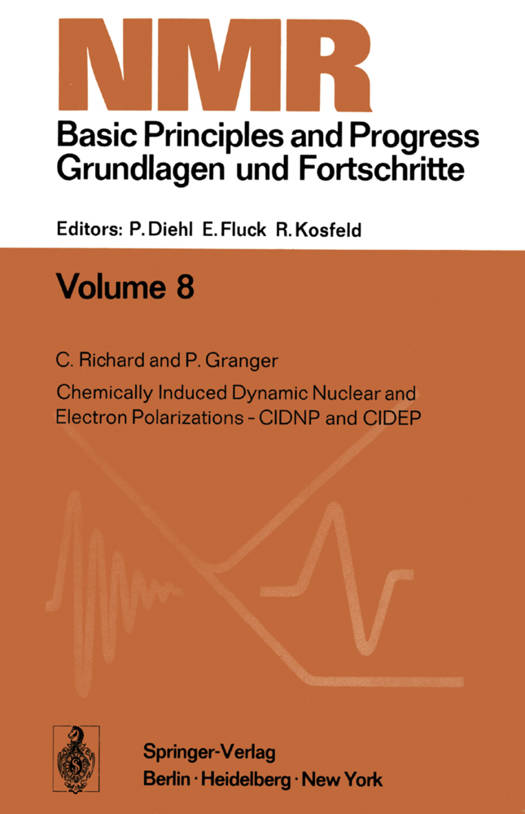
Anomalous electron-spin state populations in the Electron Paramagnetic Re- sonance (EPR) spectra of radicals formed during radio lysis experiments were observed in 1963 by FESSENDEN and SCHULER [170a]. This phenomenon did not receive much attention at the time. In 1967, BARGON, FISCHER, and JOHNSEN [5] and independently WARD and LAWLER [7,8] reported a similar phenomenon for Nuclear Magnetic Resonance (NMR) spectra taken during radical reactions: emission or enhanced absorption, or both. The earliest attempts to explain this new NMR phenomenon treated these effects in a way similar to that of Dynamic Nuclear Polarization (DNP) or the Overhauser effect. Although the polarization has a completely different origin, DNP gave its name to this effect: Chemically Induced Dynamic Nuclear Polariza- tion (CIDNP). [The name Chemically Induced Dynamic Electron Polarization (CIDEP) was introduced later by analogy with CIDNP]. After the initial publica- tions, all the new data demonstrated that the first theory could not be correct. In 1969, a new theory was proposed by CLOSS [18] and independently by KAPTEIN and OOSTERHOFF [23] and called the radical-pair theory. This mechanism was proposed to account for the observations of polarization in both NMR and EPR. The radical-pair theory is based on weak interactions in a pair of radicals: the strength of interaction between the electronic states of the radicals depends in particular on the nuclear-spin states.
Specificaties
Betrokkenen
- Auteur(s):
- Uitgeverij:
Inhoud
- Aantal bladzijden:
- 130
- Taal:
- Engels
- Reeks:
- Reeksnummer:
- nr. 8
Eigenschappen
- Productcode (EAN):
- 9783642657955
- Verschijningsdatum:
- 15/11/2011
- Uitvoering:
- Paperback
- Formaat:
- Trade paperback (VS)
- Afmetingen:
- 170 mm x 244 mm
- Gewicht:
- 226 g


Alleen bij Standaard Boekhandel
+ 324 punten op je klantenkaart van Standaard Boekhandel
Wedstrijd


Beoordelingen
We publiceren alleen reviews die voldoen aan de voorwaarden voor reviews. Bekijk onze voorwaarden voor reviews.