


- Afhalen na 1 uur in een winkel met voorraad
- Gratis thuislevering in België vanaf € 30
- Ruim aanbod met 7 miljoen producten
- Afhalen na 1 uur in een winkel met voorraad
- Gratis thuislevering in België vanaf € 30
- Ruim aanbod met 7 miljoen producten





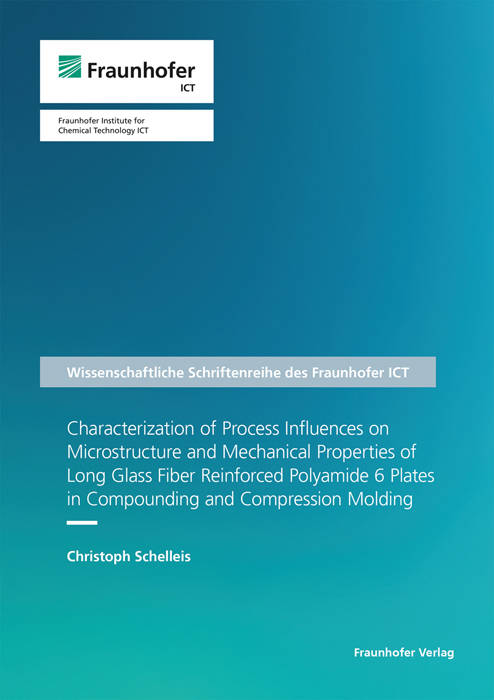
Characterization of Process Influences on Microstructure and Mechanical Properties of Long Glass Fiber Reinforced Polyamide 6 Plates in Compounding and Compression Molding
Christoph Schelleis
€ 61,45
+ 122 punten
Omschrijving
The long fiber thermoplastic direct LFT-D compression molding process allows for economical production of thin composite parts. Material innovations require a development framework from production over characterization to evaluation.
This work revolves around the material characterization during DoE process factor optimization for a compression molded glass fiber reinforced polyamide 6 composite. Resulting fiber weight contents range from 20 % to 60 %. Mechanical properties are quality features in the DoE evaluation.
The density of the plastificate is inhomogeneous. A short-shot study was conducted, and flow front skewness was found to originate in those density differences causing fiber orientation deviations after molding. Fiber content is migrating towards the end of the flow path during compression molding. These findings are discussed in regards to process factors. A high roving count has the most negative interactions and accordingly, the screw speed should be set at a medium to high level. The fiber content is the decisive influence on all properties, mechanically and microstructurally. In this framework, new LFT-D materials can be efficiently characterized.
This work revolves around the material characterization during DoE process factor optimization for a compression molded glass fiber reinforced polyamide 6 composite. Resulting fiber weight contents range from 20 % to 60 %. Mechanical properties are quality features in the DoE evaluation.
The density of the plastificate is inhomogeneous. A short-shot study was conducted, and flow front skewness was found to originate in those density differences causing fiber orientation deviations after molding. Fiber content is migrating towards the end of the flow path during compression molding. These findings are discussed in regards to process factors. A high roving count has the most negative interactions and accordingly, the screw speed should be set at a medium to high level. The fiber content is the decisive influence on all properties, mechanically and microstructurally. In this framework, new LFT-D materials can be efficiently characterized.
Specificaties
Betrokkenen
- Auteur(s):
- Uitgeverij:
Inhoud
- Taal:
- Engels
- Reeks:
- Reeksnummer:
- nr. 102
Eigenschappen
- Productcode (EAN):
- 9783839621578
- Uitvoering:
- Paperback
- Afmetingen:
- 148 mm x 210 mm


Alleen bij Standaard Boekhandel
+ 122 punten op je klantenkaart van Standaard Boekhandel
Cadeau

AANGERADEN


Beoordelingen
We publiceren alleen reviews die voldoen aan de voorwaarden voor reviews. Bekijk onze voorwaarden voor reviews.