


- Afhalen na 1 uur in een winkel met voorraad
- Gratis thuislevering in België vanaf € 30
- Ruim aanbod met 7 miljoen producten
- Afhalen na 1 uur in een winkel met voorraad
- Gratis thuislevering in België vanaf € 30
- Ruim aanbod met 7 miljoen producten





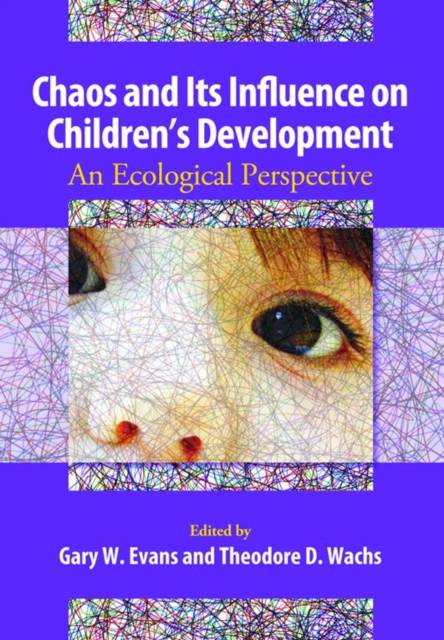
Chaos and Its Influence on Children's Development
An Ecological Perspective
Gary W. Evans, Theodore D. Wachs
€ 51,95
+ 103 punten
Omschrijving
Historically, developmental psychologists have tended to focus on the effects of understimulation and certain types of deprivation on child development. More recently researchers have shifted their attention to the deleterious effects of overstimulation or "chaos" in children's environment. Chaos refers to physical and social settings characterized by crowding, noise, unpredictability or a lack of routines, and instability or unplanned changes. This book is an important first step in exploring how, why, and at what level, chaos at the familial and societal level affects children. The contributors to the volume honor the work of Uri Bronfenbrenner, whose bioecological theory of human development provides a rich conceptual basis for understanding the impact of environmental chaos. The theory permits study at both what Bronfenbrenner called the "microsystem" level (the family, school and daycare), as well as at higher-order levels that include parents' work environments, the child's local neighborhood, and his or her cultural milieu. Within this framework, the role of individual characteristics and other moderating and mediating mechanisms can be fruitfully explored, as well as how chaos relates to poverty and culture. These elements are explored both as independent influences and collective, interrelated influences. The topics explored in this book will be thought-provoking for developmental scientists interested in the study of environmental contributions to development, as well as practitioners and policy makers interested in promoting children's healthy development.
Specificaties
Betrokkenen
- Auteur(s):
- Uitgeverij:
Inhoud
- Aantal bladzijden:
- 312
- Taal:
- Engels
- Reeks:
Eigenschappen
- Productcode (EAN):
- 9781433805653
- Verschijningsdatum:
- 1/01/2010
- Uitvoering:
- Hardcover
- Formaat:
- Genaaid
- Afmetingen:
- 183 mm x 254 mm
- Gewicht:
- 703 g



Alleen bij Standaard Boekhandel
+ 103 punten op je klantenkaart van Standaard Boekhandel
AANGERADEN


Beoordelingen
We publiceren alleen reviews die voldoen aan de voorwaarden voor reviews. Bekijk onze voorwaarden voor reviews.