


- Afhalen na 1 uur in een winkel met voorraad
- Gratis thuislevering in België vanaf € 30
- Ruim aanbod met 7 miljoen producten
- Afhalen na 1 uur in een winkel met voorraad
- Gratis thuislevering in België vanaf € 30
- Ruim aanbod met 7 miljoen producten





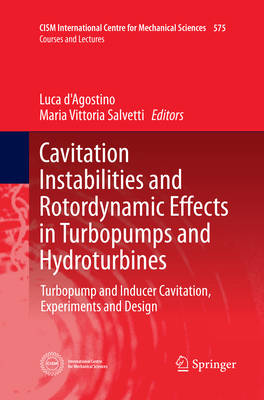
Cavitation Instabilities and Rotordynamic Effects in Turbopumps and Hydroturbines
Turbopump and Inducer Cavitation, Experiments and Design
€ 162,45
+ 324 punten
Omschrijving
The book provides a detailed approach to the physics, fluid dynamics, modeling, experimentation and numerical simulation of cavitation phenomena, with special emphasis on cavitation-induced instabilities and their implications on the design and operation of high performance turbopumps and hydraulic turbines. The first part covers the fundamentals (nucleation, dynamics, thermodynamic effects, erosion) and forms of cavitation (attached cavitation, cloud cavitation, supercavitation, vortex cavitation) relevant to hydraulic turbomachinery, illustrates modern experimental techniques for the characterization, visualization and analysis of cavitating flows, and introduces the main aspects of the hydrodynamic design and performance of axial inducers, centrifugal turbopumps and hydo-turbines. The second part focuses on the theoretical modeling, experimental analysis, and practical control of cavitation-induced fluid-dynamic and rotordynamic instabilities of hydraulic turbomachinery, with special emphasis on cavitating turbopumps (cavitation surge, rotating cavitation, higher order cavitation surge, rotordynamic whirl forces). Finally, the third part of the book illustrates the alternative approaches for the simulation of cavitating flows, with emphasis on both modeling and numerical aspects. Examples of applications to the simulation of unsteady cavitation in internal flows through hydraulic machinery are illustrated in detail.
Specificaties
Betrokkenen
- Uitgeverij:
Inhoud
- Aantal bladzijden:
- 282
- Taal:
- Engels
- Reeks:
- Reeksnummer:
- nr. 575
Eigenschappen
- Productcode (EAN):
- 9783319842233
- Verschijningsdatum:
- 20/07/2018
- Uitvoering:
- Paperback
- Afmetingen:
- 155 mm x 13 mm
- Gewicht:
- 500 g

Alleen bij Standaard Boekhandel
+ 324 punten op je klantenkaart van Standaard Boekhandel
Cadeau

AANGERADEN


Beoordelingen
We publiceren alleen reviews die voldoen aan de voorwaarden voor reviews. Bekijk onze voorwaarden voor reviews.