


- Afhalen na 1 uur in een winkel met voorraad
- Gratis thuislevering in België vanaf € 30
- Ruim aanbod met 7 miljoen producten
- Afhalen na 1 uur in een winkel met voorraad
- Gratis thuislevering in België vanaf € 30
- Ruim aanbod met 7 miljoen producten





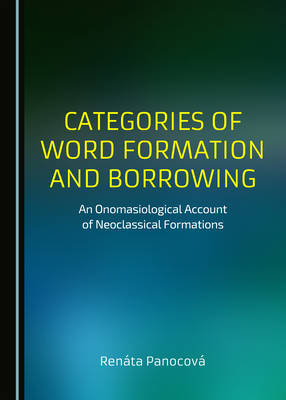
Categories of Word Formation and Borrowing
An Onomasiological Account of Neoclassical Formations
Renáta Panocová
Hardcover | Engels
€ 55,43
+ 110 punten
Omschrijving
This book presents the onomasiological approach to word formation and applies it to neoclassical formations, using data taken from English and Russian medical terminology. The phenomenon of neoclassical formations is challenging for morphological theory because it raises questions about determining its boundaries as a distinct category. The difficulties of differentiating between compounding and affixation, between blending and compounding, and between word formation and borrowing represent key problematic areas here. The basic underlying hypothesis considered in this book is that the position of neoclassical formations in English and Russian is different. It will be argued that, whereas in English, neoclassical word formation is a system of word formation, Russian has only individual borrowings. This hypothesis and the theoretical problems it entails are viewed from the perspective of Stekauer's onomasiological theory of word formation. Stekauer's theory takes the needs of the speech community as its starting point in explaining word formation. In this theory, the different analyses of neoclassical formations in English and Russian can be accounted for in an intuitively appealing and theoretically elegant way. As naming needs are central, word formation and borrowing can be analysed as alternative responses activating different components of the language system.
Specificaties
Betrokkenen
- Auteur(s):
- Uitgeverij:
Inhoud
- Aantal bladzijden:
- 175
- Taal:
- Engels
Eigenschappen
- Productcode (EAN):
- 9781443877640
- Verschijningsdatum:
- 26/08/2015
- Uitvoering:
- Hardcover
- Formaat:
- Genaaid
- Afmetingen:
- 150 mm x 208 mm
- Gewicht:
- 408 g


Alleen bij Standaard Boekhandel
+ 110 punten op je klantenkaart van Standaard Boekhandel
Cadeau

AANGERADEN


Beoordelingen
We publiceren alleen reviews die voldoen aan de voorwaarden voor reviews. Bekijk onze voorwaarden voor reviews.