


- Afhalen na 1 uur in een winkel met voorraad
- Gratis thuislevering in België vanaf € 30
- Ruim aanbod met 7 miljoen producten
- Afhalen na 1 uur in een winkel met voorraad
- Gratis thuislevering in België vanaf € 30
- Ruim aanbod met 7 miljoen producten





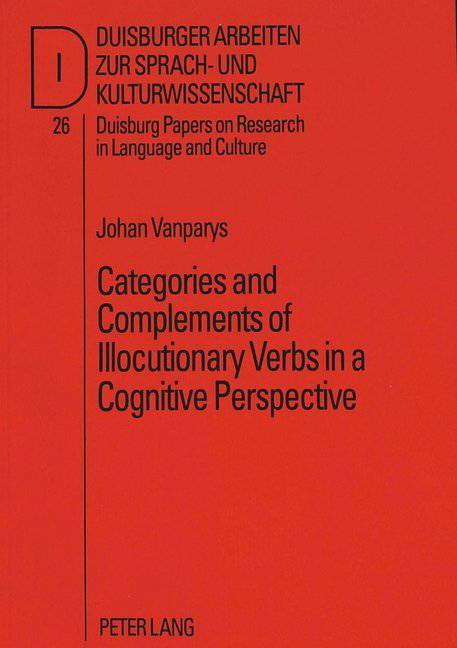
Categories and Complements of Illocutionary Verbs in a Cognitive Perspective
Dissertationsschrift
Johan Vanparys
Paperback | Engels | Dask - Duisburger Arbeiten Zur Sprach- Und Kulturwissenschaft / Duisburg Papers On Research In Langu | nr. 26
€ 70,45
+ 140 punten
Omschrijving
Several speech-act theories hinge on taxonomies which divide the total set of illocutions into mutually exclusive and homogeneous subsets. This book starts with a critical appraisal of these classifications and then suggests an alternative approach on the basis of arguments from cognitive linguistics: an analysis of illocutionary-force indicating devices, such as illocutionary verbs, which are singled out as the object of investigation because they directly name illocutions. A partial analysis of 120 illocutionary verbs is undertaken within the framework of Cognitive Grammar and based on authentic data. The verbs are analysed with regard to their valence potential, more specifically constructions involving clausal complements: direct-speech constructions, that-clauses, infinitival complements, participial complements and gerundival complements.
Specificaties
Betrokkenen
- Auteur(s):
- Uitgeverij:
Inhoud
- Aantal bladzijden:
- 254
- Taal:
- Engels
- Reeks:
- Reeksnummer:
- nr. 26
Eigenschappen
- Productcode (EAN):
- 9783631499986
- Verschijningsdatum:
- 1/05/1996
- Uitvoering:
- Paperback
- Formaat:
- Trade paperback (VS)
- Afmetingen:
- 148 mm x 210 mm
- Gewicht:
- 339 g


Alleen bij Standaard Boekhandel
+ 140 punten op je klantenkaart van Standaard Boekhandel
Cadeau

AANGERADEN


Beoordelingen
We publiceren alleen reviews die voldoen aan de voorwaarden voor reviews. Bekijk onze voorwaarden voor reviews.