



- Afhalen na 1 uur in een winkel met voorraad
- In januari gratis thuislevering in België
- Ruim aanbod met 7 miljoen producten
- Afhalen na 1 uur in een winkel met voorraad
- In januari gratis thuislevering in België
- Ruim aanbod met 7 miljoen producten





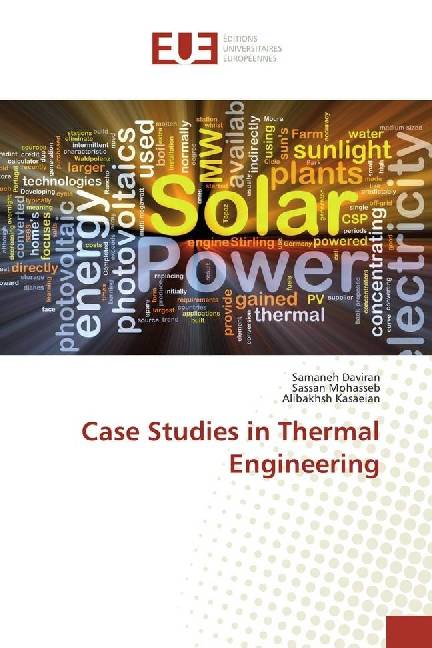
Case Studies in Thermal Engineering
Samaneh Daviran, Sassan Mohasseb, Alibakhsh Kasaeian
Paperback | Engels
€ 41,45
+ 82 punten
Omschrijving
The present book contains seven chapters, in which different thermal cases have been studied experimentally or theoretically. In Chapter one the differential quadrature method as a precised numerical method was utilized to solve the transient equations of an FGM disc under thermal shock condition. Chapter two presents a new application of image processing as a tool to study prominent heat conduction mechanism of nanofluids focusing on micro-clustering. In chapter three, the temperature and viscosity-dependent methods were used to evaluate the clustering role versus Brownian motion effect in nanofluids. In chapter four, a standard pilot of parabolic trough collector (PTC) was designed and constructed; then nanofluid was used as working fluid to study the performance enhancement. Three types of coatings, used for the absorber tube of a PTC, were compared in aspects of optical absorptance and thermal conductivity in chapter five. In chapter six and seven, a comparative study of the first and second law of thermodynamics was performed to determine the possibility of using HFO1234yf, an environmentally friendly refrigerant, as a drop-in replacement of HFC134a in air conditioning system.
Specificaties
Betrokkenen
- Auteur(s):
- Uitgeverij:
Inhoud
- Aantal bladzijden:
- 160
- Taal:
- Engels
Eigenschappen
- Productcode (EAN):
- 9783639652444
- Uitvoering:
- Paperback
- Afmetingen:
- 150 mm x 220 mm
- Gewicht:
- 230 g



Alleen bij Standaard Boekhandel
+ 82 punten op je klantenkaart van Standaard Boekhandel
Cadeau

AANGERADEN


Beoordelingen
We publiceren alleen reviews die voldoen aan de voorwaarden voor reviews. Bekijk onze voorwaarden voor reviews.