



- Afhalen na 1 uur in een winkel met voorraad
- In januari gratis thuislevering in België
- Ruim aanbod met 7 miljoen producten
- Afhalen na 1 uur in een winkel met voorraad
- In januari gratis thuislevering in België
- Ruim aanbod met 7 miljoen producten





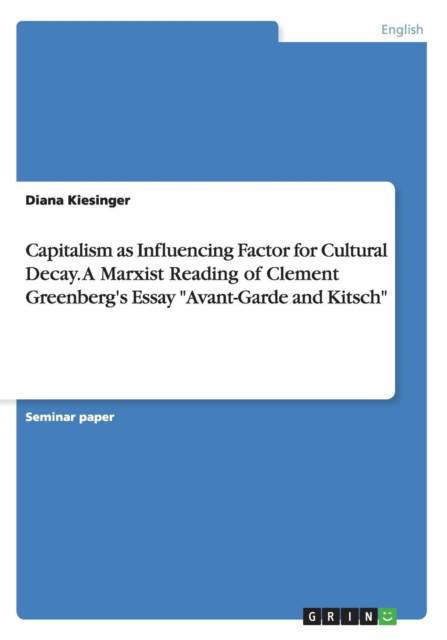
Capitalism as Influencing Factor for Cultural Decay. A Marxist Reading of Clement Greenberg's Essay "Avant-Garde and Kitsch"
Diana Kiesinger
Paperback | Engels
€ 24,45
+ 48 punten
Omschrijving
Seminar paper from the year 2013 in the subject English Language and Literature Studies - Literature, grade: 2,3, Technical University of Chemnitz (Anglistik/Amerikanistik), course: English Literature, language: English, abstract: This paper's objective is to combine the interpretation of Greenberg's art critique with respect to social and economic developments in combination with a Marxist analysis underthe superordinated thesis statement whether the modern capitalism can be held responsible for the decay of the avant-garde culture. For the purpose of providing a basis to proceed from, the following chapter is going to deal with contextual aspects such as the essay's temporal, historical and the philosophical classification. Chapter 3 is going to deal with the two confronted concepts of art: the avant-garde and kitsch. Here, the focus is laid on evaluating the distinctiveness of each particular concept and, moreover, supporting this with Greenberg's statements from the essay. In chapter 4 the paper is going to approach the outcomes of proofreading Greenberg's essay towards his Marxist standpoint and his attitude in terms of both dichotomic forms of art. Furthermore it is going to look at key thinkers of the Frankfurt school and make an attempt to support Greenberg's assertion with theoretical foundation with the aim of very- or falsifying this paper's thesis statement.
Specificaties
Betrokkenen
- Auteur(s):
- Uitgeverij:
Inhoud
- Aantal bladzijden:
- 20
- Taal:
- Engels
Eigenschappen
- Productcode (EAN):
- 9783656942825
- Verschijningsdatum:
- 24/04/2015
- Uitvoering:
- Paperback
- Afmetingen:
- 148 mm x 210 mm
- Gewicht:
- 45 g



Alleen bij Standaard Boekhandel
+ 48 punten op je klantenkaart van Standaard Boekhandel
Cadeau

AANGERADEN


Beoordelingen
We publiceren alleen reviews die voldoen aan de voorwaarden voor reviews. Bekijk onze voorwaarden voor reviews.