


- Afhalen na 1 uur in een winkel met voorraad
- Gratis thuislevering in België vanaf € 30
- Ruim aanbod met 7 miljoen producten
- Afhalen na 1 uur in een winkel met voorraad
- Gratis thuislevering in België vanaf € 30
- Ruim aanbod met 7 miljoen producten





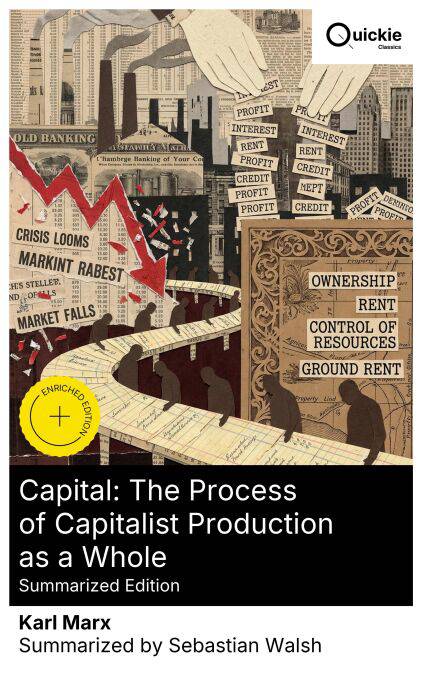
Capital: The Process of Capitalist Production as a Whole (Summarized Edition) E-BOOK
Enriched edition. A critique of political economy, labor exploitation, and class conflict in the capitalist system
Karl Marx
E-book | Engels
€ 1,99
+ 1 punten
Omschrijving
Capital: The Process of Capitalist Production as a Whole advances Marx's analysis from value production to the distributional forms of surplus value as profit, interest, and rent. Volume III traces the average rate of profit, prices of production, the credit system, joint-stock capital, merchant's capital, and ground rent, culminating in a crisis theory. Dense, dialectical, and polemically precise, it extends and corrects classical political economy. Edited posthumously by Engels from disparate manuscripts, it nonetheless attains systematic reach. Marx, a German philosopher-economist living in London exile, forged these chapters amid British Museum research and the panics of 1857–58 and 1866. Ill health, precarious finances, and leadership in the workers' movement intensified his drive to uncover capitalism's "laws of motion." Collaboration and correspondence with Engels furnished organization, editorial aid, and empirical ballast. This volume is essential for economists, historians, sociologists, and theorists seeking a rigorous account of profit rates, finance, and crisis. Demanding yet clarifying when read alongside Volumes I and II, it equips readers to analyze how modern capitalism reallocates and masks value. A landmark of critical inquiry, it repays careful, methodical study.
Quickie Classics summarizes timeless works with precision, preserving the author's voice and keeping the prose clear, fast, and readable—distilled, never diluted. Enriched Edition extras: Introduction · Synopsis · Historical Context · Author Biography · Brief Analysis · 4 Reflection Q&As · Editorial Footnotes.
Quickie Classics summarizes timeless works with precision, preserving the author's voice and keeping the prose clear, fast, and readable—distilled, never diluted. Enriched Edition extras: Introduction · Synopsis · Historical Context · Author Biography · Brief Analysis · 4 Reflection Q&As · Editorial Footnotes.
Specificaties
Betrokkenen
- Auteur(s):
- Vertaler(s):
- Uitgeverij:
Inhoud
- Aantal bladzijden:
- 309
- Taal:
- Engels
Eigenschappen
- Productcode (EAN):
- 8596547880035
- Verschijningsdatum:
- 9/01/2026
- Uitvoering:
- E-book
- Beveiligd met:
- Digital watermarking
- Formaat:
- ePub


Alleen bij Standaard Boekhandel
+ 1 punten op je klantenkaart van Standaard Boekhandel
Cadeau

AANGERADEN


Beoordelingen
We publiceren alleen reviews die voldoen aan de voorwaarden voor reviews. Bekijk onze voorwaarden voor reviews.