


- Afhalen na 1 uur in een winkel met voorraad
- Gratis thuislevering in België vanaf € 30
- Ruim aanbod met 7 miljoen producten
- Afhalen na 1 uur in een winkel met voorraad
- Gratis thuislevering in België vanaf € 30
- Ruim aanbod met 7 miljoen producten





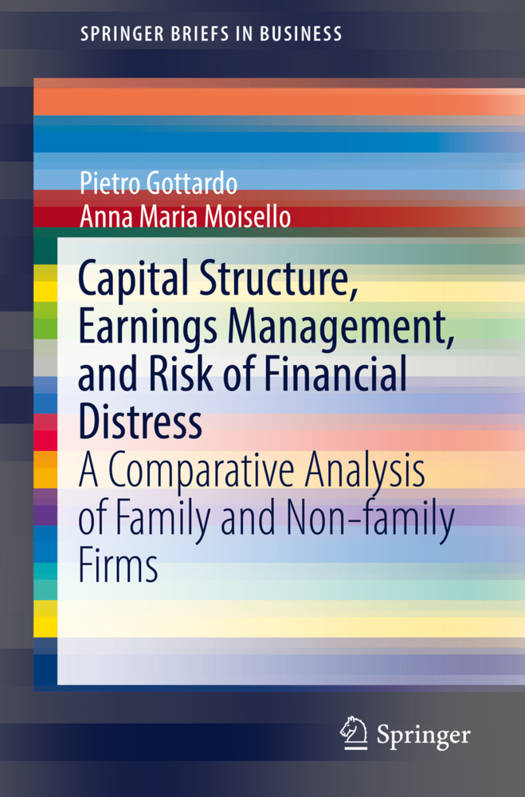
Capital Structure, Earnings Management, and Risk of Financial Distress
A Comparative Analysis of Family and Non-Family Firms
Pietro Gottardo, Anna Maria Moisello
€ 54,45
+ 108 punten
Omschrijving
This book analyzes the impacts that family control of firms has on capital structure choices, leverage and the risk of financial distress, earnings management practices, and the relation between accounting choices and firm market value. For these purposes, longitudinal data on Italian family and non-family non-financial firms are closely analyzed. The Italian setting is of special interest in this context because family businesses account for 94% of GDP, families are particularly committed to maintaining control of firms, and the economy is bank based rather than market based. The analyses draw on the socioemotional wealth approach, which emphasizes the importance of the stock of emotional value in family firms, in combination with financial theories such as Pecking Order Theory, Trade-off Theory, and Agency Theory. The findings cast significant new light on differences between family and non-family firms and the effects of different forms of family influence. The book will have broad appeal for academics, managers, practitioners, and policymakers.
Specificaties
Betrokkenen
- Auteur(s):
- Uitgeverij:
Inhoud
- Aantal bladzijden:
- 99
- Taal:
- Engels
- Reeks:
Eigenschappen
- Productcode (EAN):
- 9783030003432
- Verschijningsdatum:
- 2/10/2018
- Uitvoering:
- Paperback
- Formaat:
- Trade paperback (VS)
- Afmetingen:
- 156 mm x 234 mm
- Gewicht:
- 163 g


Alleen bij Standaard Boekhandel
+ 108 punten op je klantenkaart van Standaard Boekhandel
Cadeau

AANGERADEN


Beoordelingen
We publiceren alleen reviews die voldoen aan de voorwaarden voor reviews. Bekijk onze voorwaarden voor reviews.