


- Afhalen na 1 uur in een winkel met voorraad
- Gratis thuislevering in België vanaf € 30
- Ruim aanbod met 7 miljoen producten
- Afhalen na 1 uur in een winkel met voorraad
- Gratis thuislevering in België vanaf € 30
- Ruim aanbod met 7 miljoen producten





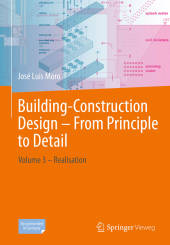
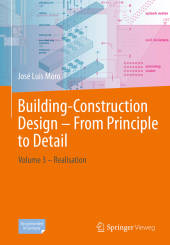
Building-Construction Design - From Principle to Detail
Volume 3 - Realisation
José Luis Moro
Paperback | Engels
€ 92,45
+ 184 punten
Uitvoering
Omschrijving
Construction is the means used by the designing architect and engineer to transform a design idea into built reality. From this perspective, the subject of 'building-construction design' is dealt with by architect José Luis Moro in four comprehensive volumes. They are respectively dedicated to the methodological, physical, and functional principles, the conception of a constructional basic solution, and finally its implementation in the constructional detail. Not only is a wide range of content covered, but the greatest possible clarity is also ensured in order to make it easier for students to access the subject matter. An important focus of the work lies both on conveying technical and scientific factual information as well as on demonstrating complex relationships and interactions between design, material, and construction. Volume 3 focuses on the constructional implementation of building designs. It begins by addressing the fundamental aspects of joints and connections and then examines the relevant connection techniques from a cross-material perspective. The central section of the volume examines building envelopes, both exterior and interior, in detail. This is done from a general perspective, primarily relating to the constructional composition of the envelope, by distinguishing between fundamental structural variants such as full-leaf or ribbed systems. Consequently, the traditional classification by building elements (exterior wall, roof)--which tends to apply to more conventional building forms--takes a back seat in favour of a more clearly structure-oriented approach.
Specificaties
Betrokkenen
- Auteur(s):
- Uitgeverij:
Inhoud
- Taal:
- Engels
Eigenschappen
- Productcode (EAN):
- 9783662735756
- Verschijningsdatum:
- 1/09/2026
- Uitvoering:
- Paperback
- Formaat:
- Trade paperback (VS)
- Afmetingen:
- 178 mm x 254 mm


Alleen bij Standaard Boekhandel
+ 184 punten op je klantenkaart van Standaard Boekhandel
Cadeau

AANGERADEN


Beoordelingen
We publiceren alleen reviews die voldoen aan de voorwaarden voor reviews. Bekijk onze voorwaarden voor reviews.