


- Afhalen na 1 uur in een winkel met voorraad
- Gratis thuislevering in België vanaf € 30
- Ruim aanbod met 7 miljoen producten
- Afhalen na 1 uur in een winkel met voorraad
- Gratis thuislevering in België vanaf € 30
- Ruim aanbod met 7 miljoen producten





€ 22,95
+ 45 punten
Omschrijving
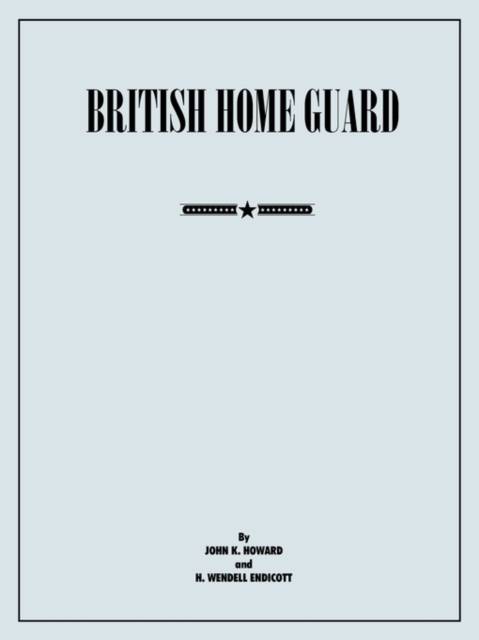
This is a high quality reprint of the original 1941 report by staff of the The Massachusetts Committee on Public Safety. In early 1941, when the threat of a German invasion was still by no means out of the question, even an invasion of America was not unimaginable. As a result, at the request of the U.S. War Department, two representatives of the Massachusetts Committee on Public Safety traveled to England to research the origins and development of the British Home Guard. Established in 1940 and originally named the Local Defense Volunteers, the Home Guard was both an early warning force and the last line of defense in case of a German invasion. British Home Guard, which was classified during the war, provides a detailed study of the organization, training, and armament of the Home Guard; its role in guarding against parachute troops (bringing about the nickname "Parashots"); and its potential as a guerrilla and sabotage force in the event of a full-scale invasion. Often viewed in retrospect as a "Dad's Army" of the elderly, this report makes clear the gravity with which an all-out German attack was viewed at the time, as well as British plans to "set England ablaze" via sabotage and irregular warfare if such an attack succeeded.
Specificaties
Betrokkenen
- Auteur(s):
- Uitgeverij:
Inhoud
- Aantal bladzijden:
- 102
- Taal:
- Engels
Eigenschappen
- Productcode (EAN):
- 9781907521416
- Verschijningsdatum:
- 1/07/2010
- Uitvoering:
- Paperback
- Formaat:
- Trade paperback (VS)
- Afmetingen:
- 210 mm x 279 mm
- Gewicht:
- 249 g


Alleen bij Standaard Boekhandel
+ 45 punten op je klantenkaart van Standaard Boekhandel

Beoordelingen
We publiceren alleen reviews die voldoen aan de voorwaarden voor reviews. Bekijk onze voorwaarden voor reviews.