


- Afhalen na 1 uur in een winkel met voorraad
- Gratis thuislevering in België vanaf € 30
- Ruim aanbod met 7 miljoen producten
- Afhalen na 1 uur in een winkel met voorraad
- Gratis thuislevering in België vanaf € 30
- Ruim aanbod met 7 miljoen producten





€ 91,95
+ 183 punten
Omschrijving
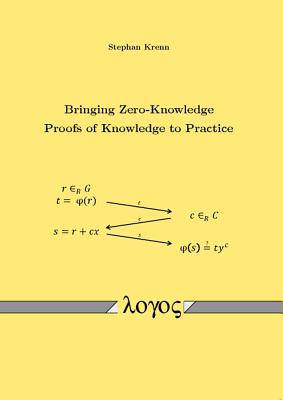
A zero-knowledge proof of knowledge allows one party to convince another party that it knows a secret piece of information without revealing anything about it. Such protocols are important building blocks for many interesting higher-level cryptographic applications, such as e-voting and e-cash systems, digital signature and identification schemes, or anonymous credential systems. Unfortunately, their high computational costs, as well as long and error-prone implementation cycles, are major hurdles on their way to real-world usage. This thesis contributes to overcoming these restrictions. On the practical side, we introduce a compiler which automatically translates natural specifications of zero-knowledge proofs into concrete implementations. In addition, it generates formal proofs that the generated protocols are indeed sound. On the theoretical side, we analyze inherent efficiency limitations of igma-protocols, proving the optimality of currently known protocols. Finally, we consider zero-knowledge proofs in the Universal Composability framework. By enabling UC-compliant proofs of existence for the first time, we are able to decrease the computational complexity of many practically relevant UC-secure zero-knowledge protocols to an acceptable level.
Specificaties
Betrokkenen
- Auteur(s):
- Uitgeverij:
Inhoud
- Aantal bladzijden:
- 170
- Taal:
- Engels
Eigenschappen
- Productcode (EAN):
- 9783832532178
- Verschijningsdatum:
- 5/09/2012
- Uitvoering:
- Paperback
- Formaat:
- Trade paperback (VS)
- Afmetingen:
- 145 mm x 211 mm
- Gewicht:
- 112 g


Alleen bij Standaard Boekhandel
+ 183 punten op je klantenkaart van Standaard Boekhandel

Beoordelingen
We publiceren alleen reviews die voldoen aan de voorwaarden voor reviews. Bekijk onze voorwaarden voor reviews.