


- Afhalen na 1 uur in een winkel met voorraad
- Gratis thuislevering in België vanaf € 30
- Ruim aanbod met 7 miljoen producten
- Afhalen na 1 uur in een winkel met voorraad
- Gratis thuislevering in België vanaf € 30
- Ruim aanbod met 7 miljoen producten





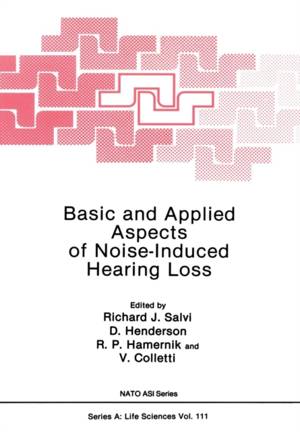
Basic and Applied Aspects of Noise-Induced Hearing Loss
Richard J Salvi, D Henderson, R P Hamernik, V Colletti
€ 153,95
+ 307 punten
Omschrijving
In September 1985, NATO sponsored an Advanced Study WOl'kshop entitled, "Noise-Induced Hearing Loss: Basic and Applied Aspects." Tne meeting was held in a mountain retreat near Lucca, Italy and was attended by scientists, clinicians, and public officials from 12 countries. This was the third in a series of such conferences organized by the authors. The first two were supported by the United States National Institute of Occupational Safety and Health; their proceedings were published as "The Effects of Noise on Hearing" in 1976 and "New Perspectives on Noise-Induced Hearing Loss" in 1982. The Organizing Committee approached NATO because it was felt that the problem of noise was common to all industrialized countries and was an especially serious problem for the military. Thus, the NATO sponsorship and the Italian site of the meeting were part of the Organizing Committee's plan to obtain an international and thorough repr'esentation on the problem of noise-induced hearing loss. The NATO meeting and proceedings followed the format of the previous two symposia with an initial focus on the anatomical and physiological disturbances resulting from noise-induced hearing loss. This was followed by sections devoted to studies of a more applied nature involving general auditory performance in noise, issues associated with the establishment of noise-exposure criteria, nonauditory effects of noise, and the interaction of noise with other agents.
Specificaties
Betrokkenen
- Auteur(s):
- Uitgeverij:
Inhoud
- Aantal bladzijden:
- 680
- Taal:
- Engels
- Reeks:
- Reeksnummer:
- nr. 111
Eigenschappen
- Productcode (EAN):
- 9781468451788
- Verschijningsdatum:
- 18/05/2012
- Uitvoering:
- Paperback
- Formaat:
- Trade paperback (VS)
- Afmetingen:
- 170 mm x 244 mm
- Gewicht:
- 1070 g


Alleen bij Standaard Boekhandel
+ 307 punten op je klantenkaart van Standaard Boekhandel
Cadeau

AANGERADEN


Beoordelingen
We publiceren alleen reviews die voldoen aan de voorwaarden voor reviews. Bekijk onze voorwaarden voor reviews.