


- Afhalen na 1 uur in een winkel met voorraad
- Gratis thuislevering in België vanaf € 30
- Ruim aanbod met 7 miljoen producten
- Afhalen na 1 uur in een winkel met voorraad
- Gratis thuislevering in België vanaf € 30
- Ruim aanbod met 7 miljoen producten





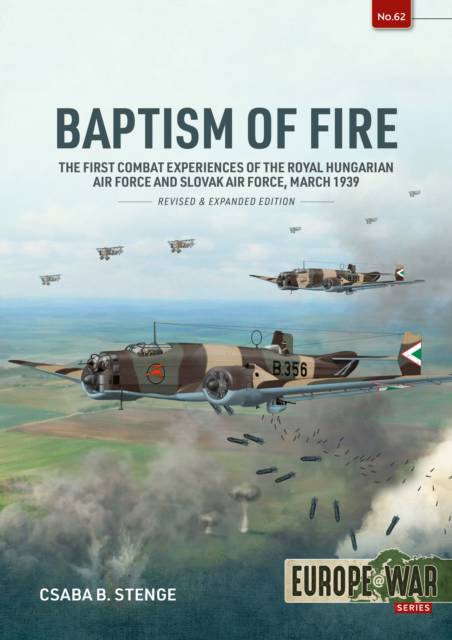
Baptism of Fire
The First Combat Experiences of the Royal Hungarian Air Force and Slovak Air Force, March 1939
Csaba B Stenge
€ 27,95
+ 55 punten
Omschrijving
Baptism of Fire explores a little-known but significant episode in the history of Central Europe on the eve of the Second World War: the brief but fierce border conflict that erupted between Hungary and the newly formed Slovak state in March 1939. While the Third Reich's annexation of Czech territories often dominates history books, Csaba B. Stenge focuses the spotlight on this parallel struggle between a newly independent Slovakia and a revisionist Hungary over the strategically vital territories of Sub-Carpathia.
The narrative provides a meticulous reconstruction of the first aerial engagements of both the nascent Royal Hungarian and Slovak Air Forces. The author explores the early reconnaissance missions, air raids, and ground support operations carried out under difficult weather conditions and with limited resources. The chaos and technical challenges of a burgeoning air war are captured in detail, including the dogfights and the retaliatory bombing raid against the Spisská Nová Ves airfield, exposing the navigational errors and tactical improvisations that defined this 'baptism of fire' for both air arms. These engagements reveal valuable insights into military preparedness, coordination, and the realities of evolving midtwentieth-century air combat.
This revised and expanded edition incorporates a thoroughly updated text, with additional detail and new insights drawn from further research by the author. The colour profile captions have been revised and extended to include additional technical and operational information on the aircraft depicted, while a number of new colour profiles have been commissioned. The volume is further enhanced by the inclusion of additional photographs and a new appendix, extending the scope and depth of the work.
Drawing on years of research using scarce surviving archives and veteran reminiscences, this volume moves beyond mere strategy to honour the human cost of the conflict, bringing clarity to events long obscured and fragmented. With detailed appendices, rare photographs, colour illustrations, and pilot biographies, it serves as an essential record for military historians and aviation enthusiasts alike, documenting a forgotten episode that fleetingly reshaped the frontiers of Central Europe.
The narrative provides a meticulous reconstruction of the first aerial engagements of both the nascent Royal Hungarian and Slovak Air Forces. The author explores the early reconnaissance missions, air raids, and ground support operations carried out under difficult weather conditions and with limited resources. The chaos and technical challenges of a burgeoning air war are captured in detail, including the dogfights and the retaliatory bombing raid against the Spisská Nová Ves airfield, exposing the navigational errors and tactical improvisations that defined this 'baptism of fire' for both air arms. These engagements reveal valuable insights into military preparedness, coordination, and the realities of evolving midtwentieth-century air combat.
This revised and expanded edition incorporates a thoroughly updated text, with additional detail and new insights drawn from further research by the author. The colour profile captions have been revised and extended to include additional technical and operational information on the aircraft depicted, while a number of new colour profiles have been commissioned. The volume is further enhanced by the inclusion of additional photographs and a new appendix, extending the scope and depth of the work.
Drawing on years of research using scarce surviving archives and veteran reminiscences, this volume moves beyond mere strategy to honour the human cost of the conflict, bringing clarity to events long obscured and fragmented. With detailed appendices, rare photographs, colour illustrations, and pilot biographies, it serves as an essential record for military historians and aviation enthusiasts alike, documenting a forgotten episode that fleetingly reshaped the frontiers of Central Europe.
Specificaties
Betrokkenen
- Auteur(s):
- Uitgeverij:
Inhoud
- Aantal bladzijden:
- 84
- Taal:
- Engels
- Reeks:
Eigenschappen
- Productcode (EAN):
- 9781806721092
- Verschijningsdatum:
- 30/06/2026
- Uitvoering:
- Paperback
- Formaat:
- Trade paperback (VS)
- Afmetingen:
- 211 mm x 297 mm


Alleen bij Standaard Boekhandel
+ 55 punten op je klantenkaart van Standaard Boekhandel
Cadeau

AANGERADEN


Beoordelingen
We publiceren alleen reviews die voldoen aan de voorwaarden voor reviews. Bekijk onze voorwaarden voor reviews.