


- Afhalen na 1 uur in een winkel met voorraad
- Gratis thuislevering in België vanaf € 30
- Ruim aanbod met 7 miljoen producten
- Afhalen na 1 uur in een winkel met voorraad
- Gratis thuislevering in België vanaf € 30
- Ruim aanbod met 7 miljoen producten





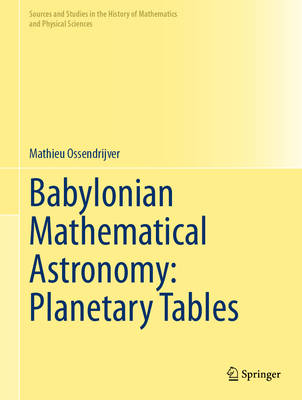
Babylonian Mathematical Astronomy: Planetary Tables
Mathieu Ossendrijver
€ 149,95
+ 299 punten
Omschrijving
This book presents new editions and investigations of 114 Babylonian planetary tables: cuneiform tablets inscribed with computed dates, positions, and other data for the planets Mercury, Venus, Mars, Jupiter, and Saturn. The tablets originate from Babylon and Uruk, two main centers of Babylonian astronomy. They were written in the period 400-50 BCE. Along with lunar tables and procedure texts they belong to a corpus of texts known as Babylonian mathematical astronomy. They contain the earliest known form of mathematical astronomy in the ancient world. All computations are based on the uniform zodiac with twelve signs of thirty degrees and the 60-based number system known as sexagesimal place value notation. The book begins with a general overview of the planetary tables, covering the history of research, a comparative analysis of various archaeological, archival, material, and notational aspects, a discussion of regional variations, scribal errors, the production process of the tables, mathematical and astronomical aspects, an overview of the tables arranged by planet and algorithm, and a study of dependencies and offsets between the tables. This is followed by editions of the tablets, including previously unpublished ones. Each commentary includes a full account of the material, archival, paleographic, orthographic, and other features of the tablet, a summary of previous research, and reconstructions of the underlying algorithms, in some cases with significant new insights about the Babylonian methods.
Specificaties
Betrokkenen
- Auteur(s):
- Uitgeverij:
Inhoud
- Aantal bladzijden:
- 573
- Taal:
- Engels
- Reeks:
Eigenschappen
- Productcode (EAN):
- 9783032191878
- Verschijningsdatum:
- 16/06/2026
- Uitvoering:
- Hardcover
- Formaat:
- Genaaid
- Afmetingen:
- 210 mm x 279 mm



Alleen bij Standaard Boekhandel
+ 299 punten op je klantenkaart van Standaard Boekhandel
Cadeau

AANGERADEN


Beoordelingen
We publiceren alleen reviews die voldoen aan de voorwaarden voor reviews. Bekijk onze voorwaarden voor reviews.