


- Afhalen na 1 uur in een winkel met voorraad
- Gratis thuislevering in België vanaf € 30
- Ruim aanbod met 7 miljoen producten
- Afhalen na 1 uur in een winkel met voorraad
- Gratis thuislevering in België vanaf € 30
- Ruim aanbod met 7 miljoen producten





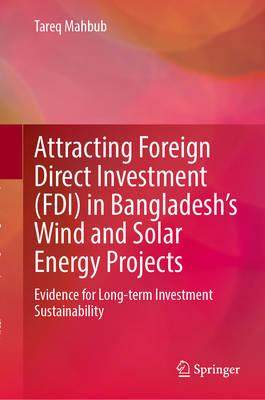
Attracting Foreign Direct Investment (Fdi) in Bangladesh's Wind and Solar Energy Projects
Evidence for Long-Term Investment Sustainability
Tareq Mahbub
Hardcover | Engels
€ 140,95
+ 281 punten
Omschrijving
This book is based on an empirical study conducted by the author in Bangladesh's renewable energy sector. This study investigates the determinants relevant for attracting wind and solar Foreign Direct Investment (FDI) into the nascent market in Bangladesh. Primarily institutional theory and Dunning's eclectic paradigm to explain multinational enterprises (MNEs) strategy and investment choices to conduct FDI in wind and solar energy projects in developing countries, the author argues that the locational aspects of the host country matter in investment decisions.
Drawing on Dunning's eclectic paradigm and institutional theory to explain multinational enterprises (MNEs) strategy and investment choices to conduct FDI in wind and solar energy projects in developing countries, the author argues that the locational aspects of the host country matter in conducting FDI in wind and solar projects in developing countries. Additionally, this study looks into the empirical studies on determinants of FDI in renewable energy sector subsumed under the three investment dimensions (i.e., institutional environment, macroeconomic environment and natural conditions). The aim of this study has three folds. First, this study identifies the factors that attract scalable wind and solar projects in Bangladesh. Second, it clarifies the relative significance of factors crucial for attracting FDI into nascent markets in Bangladesh. Third, it suggests policy implications for the sustainable development of renewable energy FDI in wind and solar in Bangladesh.
This book differs from existing studies on FDI in renewable energy across developing countries in a number of ways. First, it explores the determinants of FDI in wind and solar energy projects into a nascent market like Bangladesh, which is partially opening up for renewables (i.e., wind and solar energy) while having a significant share of fossil fuels to sustain rapid GDP growth. Second, this study underscores the influence of traditional policy instruments in guiding investment choices in Bangladesh's nascent wind and solar energy markets, as a whole set of renewable energy support policies popular in other developing countries, whose markets are gradually maturing to accept accelerated renewables (i.e., feed-in tariffs, renewable energy certificates, auctions, and renewable portfolio standards) are non-existent in Bangladesh. Third, it addresses the dual challenges faced by developing countries (i.e., Bangladesh) that must invest in achieving growth targets, often based on fossil-fuels, while committing to climate adaptation and mitigation goals. Lastly, the results of this study could be generalized to other developing countries that currently lack the globally available best practices (i.e., the various economic support measures) for deploying accelerated renewables.
Specificaties
Betrokkenen
- Auteur(s):
- Uitgeverij:
Inhoud
- Aantal bladzijden:
- 105
- Taal:
- Engels
Eigenschappen
- Productcode (EAN):
- 9783032192189
- Verschijningsdatum:
- 29/04/2026
- Uitvoering:
- Hardcover
- Formaat:
- Genaaid
- Afmetingen:
- 156 mm x 234 mm
- Gewicht:
- 349 g


Alleen bij Standaard Boekhandel
+ 281 punten op je klantenkaart van Standaard Boekhandel
Cadeau

AANGERADEN


Beoordelingen
We publiceren alleen reviews die voldoen aan de voorwaarden voor reviews. Bekijk onze voorwaarden voor reviews.