


- Afhalen na 1 uur in een winkel met voorraad
- Gratis thuislevering in België vanaf € 30
- Ruim aanbod met 7 miljoen producten
- Afhalen na 1 uur in een winkel met voorraad
- Gratis thuislevering in België vanaf € 30
- Ruim aanbod met 7 miljoen producten





€ 18,45
+ 36 punten
Uitvoering
Omschrijving
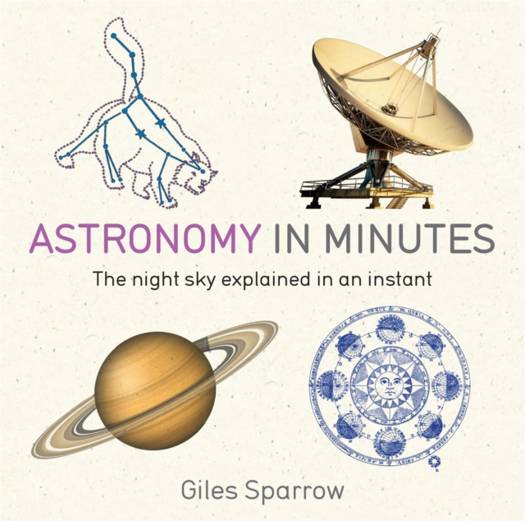
What happens when a star dies? How many asteroids are in our solar system? Can galaxies collide? What is dark energy? Astronomy in Minutes answers all these questions and more as it condenses 200 key concepts into easily digestible essays.
From Trojan asteroids to stellar black holes, and from superclusters to cosmic microwave background, this book will take you on an essential tour around the universe. Beginning with the specks and constellations that we see in the night sky, and then zooming in on the objects and matter" beyond the naked eye, Astronomy in Minutes draws on established theories and recent research.
Each essay is accompanied by an image or a clear diagram to help unravel complex ideas. Beginning with the constellations and finishing with the latest cosmological theories, this is the perfect reference guide to this fascinating subject.
Contents include: The celestial sphere, Piscis Austrinus, the Earth-Moon system, Io and Ganymede, Kuiper Belt Objects, Measuring stellar properties, Nuclear fusion, Red and orange dwarfs, Open star clusters, Planetary nebulae, Supernova remnants, Cosmic expansion, Quasars and blazars, Nature of spacetime, Nucleosynthesis and the Anthropic Principle.
From Trojan asteroids to stellar black holes, and from superclusters to cosmic microwave background, this book will take you on an essential tour around the universe. Beginning with the specks and constellations that we see in the night sky, and then zooming in on the objects and matter" beyond the naked eye, Astronomy in Minutes draws on established theories and recent research.
Each essay is accompanied by an image or a clear diagram to help unravel complex ideas. Beginning with the constellations and finishing with the latest cosmological theories, this is the perfect reference guide to this fascinating subject.
Contents include: The celestial sphere, Piscis Austrinus, the Earth-Moon system, Io and Ganymede, Kuiper Belt Objects, Measuring stellar properties, Nuclear fusion, Red and orange dwarfs, Open star clusters, Planetary nebulae, Supernova remnants, Cosmic expansion, Quasars and blazars, Nature of spacetime, Nucleosynthesis and the Anthropic Principle.
Specificaties
Betrokkenen
- Auteur(s):
- Uitgeverij:
Inhoud
- Aantal bladzijden:
- 416
- Taal:
- Engels
- Reeks:
Eigenschappen
- Productcode (EAN):
- 9781848667235
- Verschijningsdatum:
- 4/08/2015
- Uitvoering:
- Paperback
- Formaat:
- Trade paperback (VS)
- Afmetingen:
- 133 mm x 133 mm
- Gewicht:
- 358 g


Alleen bij Standaard Boekhandel
+ 36 punten op je klantenkaart van Standaard Boekhandel
Cadeau

AANGERADEN


Beoordelingen
We publiceren alleen reviews die voldoen aan de voorwaarden voor reviews. Bekijk onze voorwaarden voor reviews.