


- Afhalen na 1 uur in een winkel met voorraad
- Gratis thuislevering in België vanaf € 30
- Ruim aanbod met 7 miljoen producten
- Afhalen na 1 uur in een winkel met voorraad
- Gratis thuislevering in België vanaf € 30
- Ruim aanbod met 7 miljoen producten





€ 51,95
+ 103 punten
Omschrijving
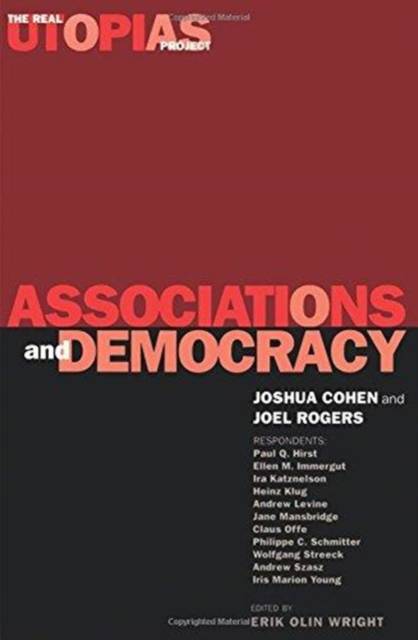
Throughout the West, democracy is under fire. "Government is part of the problem, not the solution" is a common refrain. As the tasks of the state become more complex and the size of polities larger, the institutional forms of liberal democracy developed in the 19th century seem increasingly unable to cope. Rather than seeking to deepen the democratic character of politics, much energy in recent years has been directed as reducing the role of politics altogether. In Associations and Democracy, Joshua Cohen and Joel Rogers advance an innovative scheme for rejuvenating the democratic state. Their proposal involves the strengthening of secondary associations, organizations like unions, works councils, neighborhood associations, parent-teacher groups and women's societies. With enlivened secondary associations mediating between individual citizens and the state, active participation in the political process can be expanded and democracy enhanced. Such an approach raises a number of thorny issues: Can such associations retain their independence from government if they are pulled further into the political sphere? Will a shift from territorial to functional representation further fragment an already divided polity? In an array of original contributions, leading social scientists respond to Cohen and Rogers with questions like these; Cohen and Rogers, in turn, sum up the debate. The first of a series of polemics providing workable scenarios for a progressive future, Associations and Democracy is a lively and stimulating exploration of one of the central issues on today's political agenda.
Specificaties
Betrokkenen
- Auteur(s):
- Uitgeverij:
Inhoud
- Aantal bladzijden:
- 288
- Taal:
- Engels
- Reeks:
- Reeksnummer:
- nr. 1
Eigenschappen
- Productcode (EAN):
- 9781859840481
- Verschijningsdatum:
- 17/12/1995
- Uitvoering:
- Paperback
- Formaat:
- Trade paperback (VS)
- Afmetingen:
- 154 mm x 234 mm
- Gewicht:
- 458 g



Alleen bij Standaard Boekhandel
+ 103 punten op je klantenkaart van Standaard Boekhandel
Cadeau

AANGERADEN


Beoordelingen
We publiceren alleen reviews die voldoen aan de voorwaarden voor reviews. Bekijk onze voorwaarden voor reviews.