


- Afhalen na 1 uur in een winkel met voorraad
- Gratis thuislevering in België vanaf € 30
- Ruim aanbod met 7 miljoen producten
- Afhalen na 1 uur in een winkel met voorraad
- Gratis thuislevering in België vanaf € 30
- Ruim aanbod met 7 miljoen producten





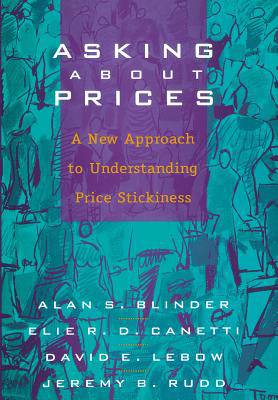
Asking about Prices
A New Approach to Understanding Price Stickiness
Alan Blinder, Elie R D Canetti, David E LeBow, Jeremy B Rudd
Hardcover | Engels
€ 76,45
+ 152 punten
Omschrijving
Why do consumer prices and wages adjust so slowly to changes in market conditions? The rigidity or stickiness of price setting in business is central to Keynesian economic theory and a key to understanding how monetary policy works, yet economists have made little headway in determining why it occurs. Asking About Prices offers a groundbreaking empirical approach to a puzzle for which theories abound but facts are scarce. Leading economist Alan Blinder, along with co-authors Elie Canetti, David Lebow, and Jeremy B. Rudd, interviewed a national, multi-industry sample of 200 CEOs, company heads, and other corporate price setters to test the validity of twelve prominent theories of price stickiness. Using everyday language and pertinent scenarios, the carefully designed survey asked decisionmakers how prominently these theoretical concerns entered into their own attitudes and thought processes. Do businesses tend to view the costs of changing prices as prohibitive? Do they worry that lower prices will be equated with poorer quality goods? Are firms more likely to try alternate strategies to changing prices, such as warehousing excess inventory or improving their quality of service? To what extent are prices held in place by contractual agreements, or by invisible handshakes? Asking About Prices offers a gold mine of previously unavailable information. It affirms the widespread presence of price stickiness in American industry, and offers the only available guide to such business details as what fraction of goods are sold by fixed price contract, how often transactions involve repeat customers, and how and when firms review their prices. Some results are surprising: contrary to popular wisdom, prices do not increase more easily than they decrease, and firms do not appear to practice anticipatory pricing, even when they can foresee cost increases. Asking About Prices also offers a chapter-by-chapter review of the survey findings for each of the twelve theories of price stickiness. The authors determine which theories are most popular with actual price setters, how practices vary within different business sectors, across firms of different sizes, and so on. They also direct economists' attention toward a rationale for price stickiness that does not stem from conventional theory, namely a strong reluctance by firms to antagonize or inconvenience their customers. By illuminating how company executives actually think about price setting, Asking About Prices provides an elegant model of a valuable new approach to conducting economic research.
Specificaties
Betrokkenen
- Auteur(s):
- Uitgeverij:
Inhoud
- Aantal bladzijden:
- 394
- Taal:
- Engels
Eigenschappen
- Productcode (EAN):
- 9780871541215
- Verschijningsdatum:
- 08/01/1998
- Uitvoering:
- Hardcover
- Formaat:
- Genaaid
- Afmetingen:
- 160 mm x 236 mm
- Gewicht:
- 725 g


Alleen bij Standaard Boekhandel
+ 152 punten op je klantenkaart van Standaard Boekhandel
Cadeau

AANGERADEN


Beoordelingen
We publiceren alleen reviews die voldoen aan de voorwaarden voor reviews. Bekijk onze voorwaarden voor reviews.