


- Afhalen na 1 uur in een winkel met voorraad
- Gratis thuislevering in België vanaf € 30
- Ruim aanbod met 7 miljoen producten
- Afhalen na 1 uur in een winkel met voorraad
- Gratis thuislevering in België vanaf € 30
- Ruim aanbod met 7 miljoen producten





€ 27,95
+ 55 punten
Omschrijving
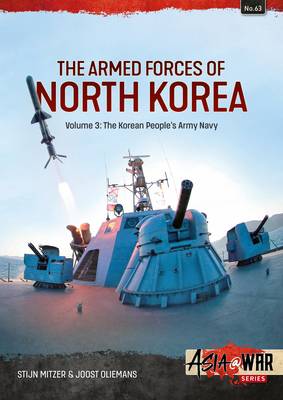
A comprehensive analysis of North Korea's navy, revealing its organization, capabilities, history, and strategic role.
Shrouded in secrecy and distorted by decades of propaganda, the naval arm of the Korean People's Army remains one of the least understood components of the DPRK's military power. Overshadowed by North Korea's nuclear and missile programmes, the Korean People's Army Navy (KPAN) is often dismissed as obsolete or strategically irrelevant. This volume challenges that assumption.
Drawing on a wide range of open-source intelligence, imagery analysis, and comparative naval assessment, The Armed Forces of North Korea Volume 3 provides a detailed and systematic examination of the organisation, doctrine, equipment, and operational role of the KPAN. It traces the historical development of North Korea's naval forces, explains their command structure and deployment across the East and West Sea fleets, and analyses how geography, technology, and ideology have shaped their missions and limitations.
The book examines the full spectrum of North Korean naval capabilities, including coastal defence forces, fast attack craft, midget and conventional submarines, amphibious and infiltration units, naval aviation, and special operations elements. Particular attention is paid to the navy's role within the DPRK's wider warfighting concept, including infiltration operations, asymmetric maritime warfare, and coordination with ground and missile forces in a potential conflict on the Korean Peninsula.
Rather than treating the KPAN as a relic of the Cold War, this study places recent modernisation efforts, shipbuilding programmes, and evolving operational concepts in their proper strategic context. It shows how, despite severe economic constraints, North Korea continues to maintain a maritime force designed to exploit regional geography, overwhelm defences through numbers and surprise, and complicate any allied response in the opening phases of war.
Originally published as part of The Armed Forces of North Korea: On the Path of Songun, this revised and updated edition has been expanded for the Asia@War series. It provides readers with a clear, structured, and realistic understanding of one of the most opaque naval forces in the world--and an essential corrective to simplistic assessments of North Korea's conventional military power.
Shrouded in secrecy and distorted by decades of propaganda, the naval arm of the Korean People's Army remains one of the least understood components of the DPRK's military power. Overshadowed by North Korea's nuclear and missile programmes, the Korean People's Army Navy (KPAN) is often dismissed as obsolete or strategically irrelevant. This volume challenges that assumption.
Drawing on a wide range of open-source intelligence, imagery analysis, and comparative naval assessment, The Armed Forces of North Korea Volume 3 provides a detailed and systematic examination of the organisation, doctrine, equipment, and operational role of the KPAN. It traces the historical development of North Korea's naval forces, explains their command structure and deployment across the East and West Sea fleets, and analyses how geography, technology, and ideology have shaped their missions and limitations.
The book examines the full spectrum of North Korean naval capabilities, including coastal defence forces, fast attack craft, midget and conventional submarines, amphibious and infiltration units, naval aviation, and special operations elements. Particular attention is paid to the navy's role within the DPRK's wider warfighting concept, including infiltration operations, asymmetric maritime warfare, and coordination with ground and missile forces in a potential conflict on the Korean Peninsula.
Rather than treating the KPAN as a relic of the Cold War, this study places recent modernisation efforts, shipbuilding programmes, and evolving operational concepts in their proper strategic context. It shows how, despite severe economic constraints, North Korea continues to maintain a maritime force designed to exploit regional geography, overwhelm defences through numbers and surprise, and complicate any allied response in the opening phases of war.
Originally published as part of The Armed Forces of North Korea: On the Path of Songun, this revised and updated edition has been expanded for the Asia@War series. It provides readers with a clear, structured, and realistic understanding of one of the most opaque naval forces in the world--and an essential corrective to simplistic assessments of North Korea's conventional military power.
Specificaties
Betrokkenen
- Auteur(s):
- Uitgeverij:
Inhoud
- Aantal bladzijden:
- 80
- Taal:
- Engels
- Reeks:
Eigenschappen
- Productcode (EAN):
- 9781806722181
- Verschijningsdatum:
- 30/04/2026
- Uitvoering:
- Paperback
- Formaat:
- Trade paperback (VS)
- Afmetingen:
- 211 mm x 297 mm
- Gewicht:
- 317 g


Alleen bij Standaard Boekhandel
+ 55 punten op je klantenkaart van Standaard Boekhandel
Cadeau

AANGERADEN


Beoordelingen
We publiceren alleen reviews die voldoen aan de voorwaarden voor reviews. Bekijk onze voorwaarden voor reviews.