


- Afhalen na 1 uur in een winkel met voorraad
- Gratis thuislevering in België vanaf € 30
- Ruim aanbod met 7 miljoen producten
- Afhalen na 1 uur in een winkel met voorraad
- Gratis thuislevering in België vanaf € 30
- Ruim aanbod met 7 miljoen producten





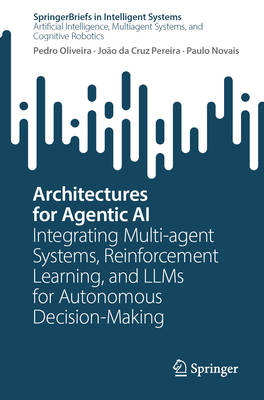
Architectures for Agentic AI
Integrating Multi-Agent Systems, Reinforcement Learning, and Llms for Autonomous Decision-Making
Pedro Oliveira, João Da Cruz Pereira, Paulo Novais
€ 54,45
+ 108 punten
Omschrijving
This book explores the emerging paradigm of Agentic AI, where Large Language Models (LLMs) and Reinforcement Learning (RL) converge to create intelligent, autonomous, and adaptive systems. It provides a unified theoretical foundation and connects it to practical implementation, offering readers a clear path from concept to execution. It will also provide an integrative approach of Agentic AI, Large Language Models, and Reinforcement Learning. While these topics are often studied separately, this book provides a coherent framework that unites them, filling a critical gap between AI theory, system design, and real-world application. In an era of rapidly evolving AI technologies, understanding how Agentic AI systems operate, and how they differ from traditional AI, is essential. This book guides researchers, engineers, and AI practitioners through the architectural principles that empower agents to reason, cooperate, and learn from feedback. It further demonstrates how RL can fine-tune LLMs to produce more focused, context-aware outputs, strengthening their role in multi-agent collaboration and autonomous decision-making. The content unfolds from the evolution of AI to Agentic AI, covering architectural design, learning mechanisms, and integration strategies for LLMs and RL. A real-world case study anchors the theory in practice, illustrating how these technologies can be combined to build interpretable systems. Readers will discover adaptive orchestration strategies, methods for enhancing model interpretability, and design templates for developing intelligent agent ecosystems. By the end, readers will not only understand the inner workings of Agentic AI but also gain the tools to design and implement their own agent-based frameworks. A working knowledge of Python is recommended to fully engage with the practical aspects.
Specificaties
Betrokkenen
- Auteur(s):
- Uitgeverij:
Inhoud
- Aantal bladzijden:
- 94
- Taal:
- Engels
- Reeks:
Eigenschappen
- Productcode (EAN):
- 9783032247803
- Verschijningsdatum:
- 1/07/2026
- Uitvoering:
- Paperback
- Formaat:
- Trade paperback (VS)
- Afmetingen:
- 155 mm x 235 mm


Alleen bij Standaard Boekhandel
+ 108 punten op je klantenkaart van Standaard Boekhandel
Cadeau

AANGERADEN


Beoordelingen
We publiceren alleen reviews die voldoen aan de voorwaarden voor reviews. Bekijk onze voorwaarden voor reviews.