



Bedankt voor het vertrouwen het afgelopen jaar! Om jou te bedanken bieden we GRATIS verzending (in België) aan op alles gedurende de hele maand januari.
- Afhalen na 1 uur in een winkel met voorraad
- In januari gratis thuislevering in België
- Ruim aanbod met 7 miljoen producten
Bedankt voor het vertrouwen het afgelopen jaar! Om jou te bedanken bieden we GRATIS verzending (in België) aan op alles gedurende de hele maand januari.
- Afhalen na 1 uur in een winkel met voorraad
- In januari gratis thuislevering in België
- Ruim aanbod met 7 miljoen producten





Omschrijving
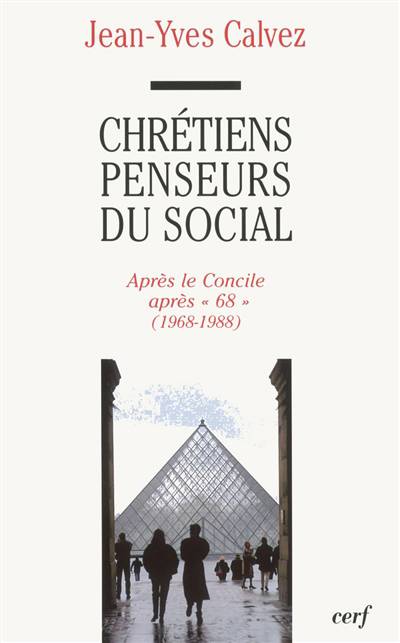
On connaît l'enseignement social de l'Église, c'est-à-dire du pape, des évêques, du Concile. Il existe, à côté de cet enseignement, tout un travail, une réflexion, des recherches menées par des penseurs indépendants qui d'ailleurs, souvent, alimentent la pensée officielle, la provoquent, la rénovent. Ceux-là sont méconnus, ou trop vite oubliés. Après avoir étudié la génération des années trente (Maritain, Lubac, Mounier), puissante et rénovatrice - une source toujours féconde et stimulante pour nous aujourd'hui -, après s'être attaché à la période de reconstruction de l'après-guerre et de la préparation du Concile, durant laquelle les chrétiens furent très impliqués dans les questions sociales - sous la double influence du message évangélique et de la confrontation au marxisme -, Jean-Yves Calvez s'intéresse aux vingt années qui suivirent le Concile, qui suivirent la révolte sociale de 68, et aux questions qui agitèrent la société et l'Église d'alors, en France - de R. Coste à P. Valadier en passant par M.-D. Chenu et C. Geffré -, mais aussi dans le reste de l'Europe et en Amérique - avec K. Rahner, R. Buttiglione ou M. Novak et les théologiens de la libération. Dans ce tour d'horizon d'une période bouillonnante, d'une période contrastée où le christianisme est aux prises avec la société, on observera, à terme, un déplacement dans les préoccupations des penseurs chrétiens du social : beaucoup de forces ont été consacrées à la relation entre la promotion, ou libération humaine et le salut chrétien, ainsi qu'au rapport entre la foi et la politique.
--
The social teaching of the Church is well-known: that of the Pope, bishops, the Council. But besides that teaching, there is reflection, the substantial study of research done by independent thinkers who often contribute to the Church's official position, questioning and renovating. They are little-known, and all too soon forgotten. Jean-Yves Calvez studies the generation of the thirties (Maritain, Lubac, Mounier), powerful and reforming - an ever-fertile and stimulating source for today - and explores the post-war period of reconstruction and preparation for the Council during which Christians were deeply involved in social issues under the dual influence of the Gospel message and the challenge of Marxism. The author then goes on to investigate the twenty years that followed the Council and the social uprising of 68, and the questions which faced society and the Church at that time in France - from R. Coste to P. Valadier, taking in M.D. Chenu and C. Geffré - but also in the rest of Europe and in America, with K. Rahner, R. Buttiglione and M. Novak and the theologians of the liberation. In this synopsis of a turbulent period, a time of contrasts when Christianity was wrestling with society, we observe a shift in Christian thinkers' positions on social subjects: a great deal of energy was devoted to the relation between human promotion, or liberation, and Christian salvation, as well as the relation between faith and politics.
--
The social teaching of the Church is well-known: that of the Pope, bishops, the Council. But besides that teaching, there is reflection, the substantial study of research done by independent thinkers who often contribute to the Church's official position, questioning and renovating. They are little-known, and all too soon forgotten. Jean-Yves Calvez studies the generation of the thirties (Maritain, Lubac, Mounier), powerful and reforming - an ever-fertile and stimulating source for today - and explores the post-war period of reconstruction and preparation for the Council during which Christians were deeply involved in social issues under the dual influence of the Gospel message and the challenge of Marxism. The author then goes on to investigate the twenty years that followed the Council and the social uprising of 68, and the questions which faced society and the Church at that time in France - from R. Coste to P. Valadier, taking in M.D. Chenu and C. Geffré - but also in the rest of Europe and in America, with K. Rahner, R. Buttiglione and M. Novak and the theologians of the liberation. In this synopsis of a turbulent period, a time of contrasts when Christianity was wrestling with society, we observe a shift in Christian thinkers' positions on social subjects: a great deal of energy was devoted to the relation between human promotion, or liberation, and Christian salvation, as well as the relation between faith and politics.
Specificaties
Betrokkenen
- Auteur(s):
- Uitgeverij:
Inhoud
- Aantal bladzijden:
- 288
- Taal:
- Frans
- Reeks:
- Reeksnummer:
- nr. 3
Eigenschappen
- Productcode (EAN):
- 9782204087384
- Verschijningsdatum:
- 6/11/2008
- Uitvoering:
- Paperback
- Afmetingen:
- 140 mm x 220 mm
- Gewicht:
- 352 g


Alleen bij Standaard Boekhandel
+ 54 punten op je klantenkaart van Standaard Boekhandel
SOLDEN


Beoordelingen
We publiceren alleen reviews die voldoen aan de voorwaarden voor reviews. Bekijk onze voorwaarden voor reviews.