


- Afhalen na 1 uur in een winkel met voorraad
- Gratis thuislevering in België vanaf € 30
- Ruim aanbod met 7 miljoen producten
- Afhalen na 1 uur in een winkel met voorraad
- Gratis thuislevering in België vanaf € 30
- Ruim aanbod met 7 miljoen producten





€ 93,45
+ 186 punten
Omschrijving
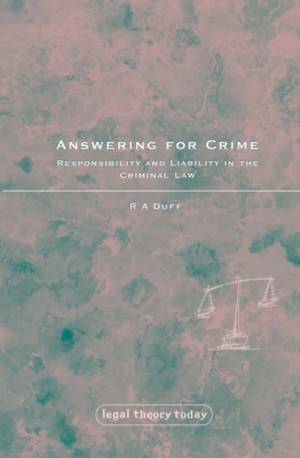
In this long-awaited book, Antony Duff offers a new perspective on the structures of criminal law and criminal liability. His starting point is a distinction between responsibility (understood as answerability) and liability, and a conception of responsibility as relational and practice-based. This focus on responsibility, as a matter of being answerable to those who have the standing to call one to account, throws new light on a range of questions in criminal law theory: on the question of criminalisation, which can now be cast as the question of what we should have to answer for, and to whom, under the threat of criminal conviction and punishment; on questions about the criminal trial, as a process through which defendants are called to answer, and about the conditions (bars to trial) given which a trial would be illegitimate; on questions about the structure of offences, the distinction between offences and defences, and the phenomena of strict liability and strict responsibility; and on questions about the structures of criminal defences. The net result is not a theory of criminal law; but it is an account of the structure of criminal law as an institution through which a liberal polity defines a realm of public wrongdoing, and calls those who perpetrate (or are accused of perpetrating) such wrongs to account.
Specificaties
Betrokkenen
- Auteur(s):
- Uitgeverij:
Inhoud
- Aantal bladzijden:
- 342
- Taal:
- Engels
- Reeks:
- Reeksnummer:
- nr. 13
Eigenschappen
- Productcode (EAN):
- 9781849460330
- Verschijningsdatum:
- 1/09/2009
- Uitvoering:
- Paperback
- Formaat:
- Trade paperback (VS)
- Afmetingen:
- 156 mm x 234 mm
- Gewicht:
- 485 g


Alleen bij Standaard Boekhandel
+ 186 punten op je klantenkaart van Standaard Boekhandel
CADEAU

AANGERADEN


Beoordelingen
We publiceren alleen reviews die voldoen aan de voorwaarden voor reviews. Bekijk onze voorwaarden voor reviews.