


- Afhalen na 1 uur in een winkel met voorraad
- Gratis thuislevering in België vanaf € 30
- Ruim aanbod met 7 miljoen producten
- Afhalen na 1 uur in een winkel met voorraad
- Gratis thuislevering in België vanaf € 30
- Ruim aanbod met 7 miljoen producten





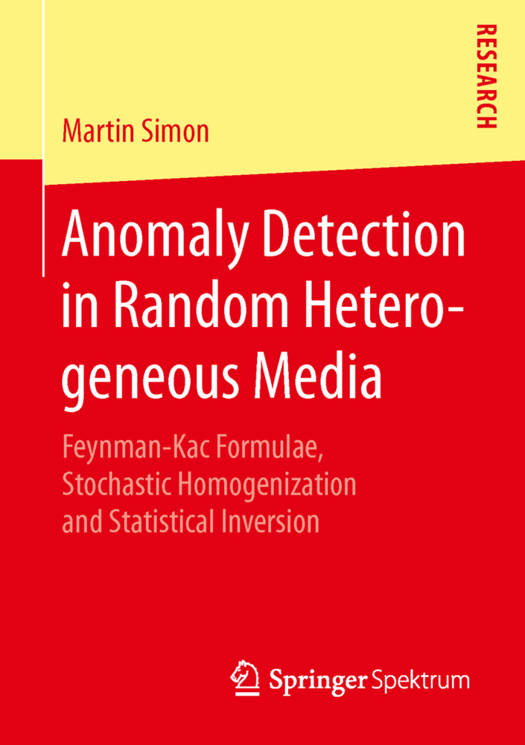
Anomaly Detection in Random Heterogeneous Media
Feynman-Kac Formulae, Stochastic Homogenization and Statistical Inversion
Martin Simon
Paperback | Engels
€ 54,45
+ 108 punten
Omschrijving
This monograph is concerned with the analysis and numerical solution of a stochastic inverse anomaly detection problem in electrical impedance tomography (EIT). Martin Simon studies the problem of detecting a parameterized anomaly in an isotropic, stationary and ergodic conductivity random field whose realizations are rapidly oscillating. For this purpose, he derives Feynman-Kac formulae to rigorously justify stochastic homogenization in the case of the underlying stochastic boundary value problem. The author combines techniques from the theory of partial differential equations and functional analysis with probabilistic ideas, paving the way to new mathematical theorems which may be fruitfully used in the treatment of the problem at hand. Moreover, the author proposes an efficient numerical method in the framework of Bayesian inversion for the practical solution of the stochastic inverse anomaly detection problem.
Specificaties
Betrokkenen
- Auteur(s):
- Uitgeverij:
Inhoud
- Aantal bladzijden:
- 150
- Taal:
- Engels
Eigenschappen
- Productcode (EAN):
- 9783658109929
- Verschijningsdatum:
- 30/07/2015
- Uitvoering:
- Paperback
- Formaat:
- Trade paperback (VS)
- Afmetingen:
- 148 mm x 210 mm
- Gewicht:
- 222 g


Alleen bij Standaard Boekhandel
+ 108 punten op je klantenkaart van Standaard Boekhandel
Cadeau

AANGERADEN


Beoordelingen
We publiceren alleen reviews die voldoen aan de voorwaarden voor reviews. Bekijk onze voorwaarden voor reviews.