


- Afhalen na 1 uur in een winkel met voorraad
- Gratis thuislevering in België vanaf € 30
- Ruim aanbod met 7 miljoen producten
- Afhalen na 1 uur in een winkel met voorraad
- Gratis thuislevering in België vanaf € 30
- Ruim aanbod met 7 miljoen producten





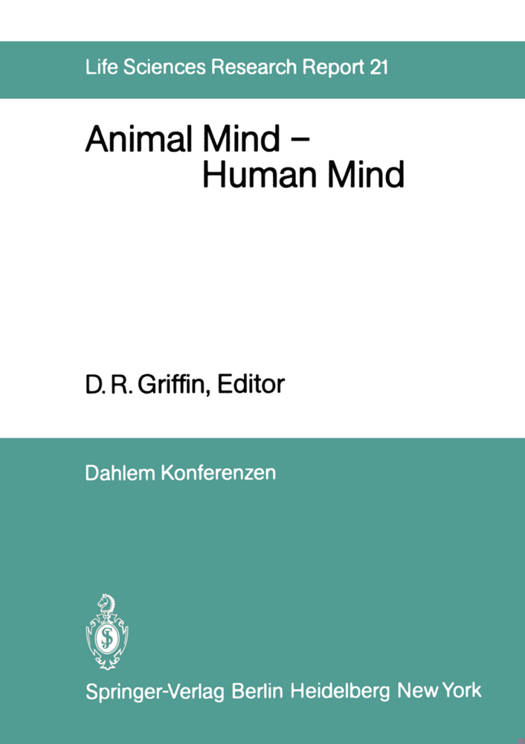
Animal Mind -- Human Mind
Report of the Dahlem Workshop on Animal Mind -- Human Mind, Berlin 1981, March 22-27
€ 137,28
+ 274 punten
Omschrijving
the oleic acid on a live and wriggling sister or mother and refrain from evicting her from our hive. But does the occur- rence of unintelligent behavior suffice to demonstrate the total absence of mental experience under any circumstances? Ethologists from some distant galaxy could easily discern ex- amples of stupid and maladaptive behavior in our own species. But do instances of human stupidity prove that none of us is ever consciously aware of what he is dOing? No available evi- dence compels us to believe that insects, or any other animals, experience any sort of consciousness, or intentionally plan any of their behavior. But neither are we compelled to believe the contrary. In areas where data are few and of limited rel- evance, dogmatic negativity can easily limit what scientists even try to investigate, and thus perhaps delay or prevent im- portant insights and discoveries. Many of the participants agreed that a good starting point would be to consider what we know of our own thinking, subjec- tive feelings, and consciousness, and then move on to inquire whether other species experience anything similar. Such an ap- proach was once considered fallaciously anthropomorphic. But it seems now to be widely if not universally recognized that this is a serious objection only if one has already assumed in advance that conscious thinking is uniquely human, and the accu- sation of anthropomorphism is then merely a reiteration of the prior conviction.
Specificaties
Betrokkenen
- Uitgeverij:
Inhoud
- Aantal bladzijden:
- 430
- Taal:
- Engels
- Reeks:
- Reeksnummer:
- nr. 21
Eigenschappen
- Productcode (EAN):
- 9783642684715
- Verschijningsdatum:
- 7/12/2011
- Uitvoering:
- Paperback
- Formaat:
- Trade paperback (VS)
- Afmetingen:
- 148 mm x 210 mm
- Gewicht:
- 526 g


Alleen bij Standaard Boekhandel
+ 274 punten op je klantenkaart van Standaard Boekhandel

Beoordelingen
We publiceren alleen reviews die voldoen aan de voorwaarden voor reviews. Bekijk onze voorwaarden voor reviews.