


- Afhalen na 1 uur in een winkel met voorraad
- Gratis thuislevering in België vanaf € 30
- Ruim aanbod met 7 miljoen producten
- Afhalen na 1 uur in een winkel met voorraad
- Gratis thuislevering in België vanaf € 30
- Ruim aanbod met 7 miljoen producten





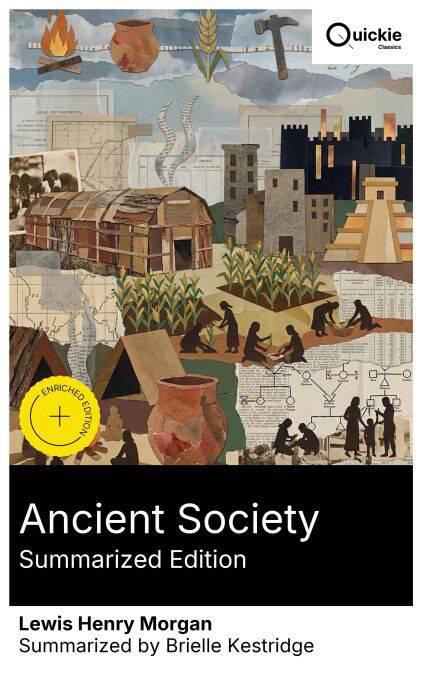
Ancient Society (Summarized Edition) E-BOOK
Enriched edition. An Anthropological Inquiry into Cultural Evolution, Kinship, Social Structures, and Technology from Prehistory to Indigenous Societies
Lewis Henry Morgan
E-book | Engels
€ 1,99
+ 1 punten
Eenvoudig bestellen
Veilig betalen


Onmiddellijk geleverd via e-mail
Omschrijving
Ancient Society (1877) proposes a unilineal sequence from Savagery to Barbarism to Civilization, keyed to pivotal inventions—fire, pottery, agriculture, metallurgy, writing—and to linked changes in kinship, property, and government. Drawing expansive comparative evidence, prominently from Iroquoian institutions, Morgan fuses ethnographic observation with stadial history. His taxonomic chapters on systems of consanguinity and on family forms (consanguine, punaluan, syndyasmian, monogamous) advance a materialist claim: subsistence and technology restructure social organization. An American lawyer turned ethnologist, Morgan built the book on long collaboration with Haudenosaunee interlocutors—especially Ely S. Parker—on adoption into a Seneca clan, and on a worldwide questionnaire cataloging kinship terms. Preceded by The League of the Iroquois and Systems of Consanguinity, his project married legal habit, field method, and nineteenth-century evolutionism to derive a "science of institutions" linking household, property, and the state. Read critically for its Eurocentric teleology, Ancient Society remains foundational: it seeded kinship studies and informed Marx and Engels's historical materialism. Students and scholars of anthropology, history, classics, and Indigenous studies will find both archive and argument here—a bold, flawed, and still generative attempt to explain how technologies of subsistence reconfigure families, ownership, and political authority.
Quickie Classics summarizes timeless works with precision, preserving the author's voice and keeping the prose clear, fast, and readable—distilled, never diluted. Enriched Edition extras: Introduction · Synopsis · Historical Context · Brief Analysis · 4 Reflection Q&As · Editorial Footnotes.
Quickie Classics summarizes timeless works with precision, preserving the author's voice and keeping the prose clear, fast, and readable—distilled, never diluted. Enriched Edition extras: Introduction · Synopsis · Historical Context · Brief Analysis · 4 Reflection Q&As · Editorial Footnotes.
Specificaties
Betrokkenen
- Auteur(s):
- Uitgeverij:
Inhoud
- Aantal bladzijden:
- 167
- Taal:
- Engels
Eigenschappen
- Productcode (EAN):
- 8596547880905
- Verschijningsdatum:
- 9/01/2026
- Uitvoering:
- E-book
- Beveiligd met:
- Digital watermarking
- Formaat:
- ePub


Alleen bij Standaard Boekhandel
+ 1 punten op je klantenkaart van Standaard Boekhandel
CADEAU

AANGERADEN


Beoordelingen
We publiceren alleen reviews die voldoen aan de voorwaarden voor reviews. Bekijk onze voorwaarden voor reviews.