


- Afhalen na 1 uur in een winkel met voorraad
- Gratis thuislevering in België vanaf € 30
- Ruim aanbod met 7 miljoen producten
- Afhalen na 1 uur in een winkel met voorraad
- Gratis thuislevering in België vanaf € 30
- Ruim aanbod met 7 miljoen producten





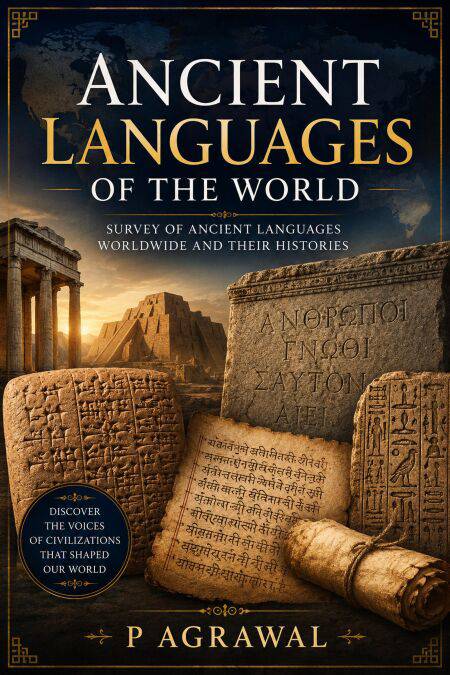
Ancient Languages Of The World: Survey of ancient languages worldwide and their histories E-BOOK
J Jones, P. Agrawal
E-book | Engels
€ 2,99
+ 2 punten
Omschrijving
Ancient Languages Of The World by P Agrawal is a fascinating nonfiction survey of the languages, scripts, and written traditions that shaped early human civilization. The book explores how ancient languages were created, recorded, preserved, lost, and rediscovered through inscriptions, manuscripts, tablets, monuments, and oral traditions. It presents language not merely as a collection of words, but as a living tool through which societies organized trade, law, religion, memory, education, power, and identity.
The book begins by explaining what makes a language "ancient" and why the evidence for ancient languages is often uneven. Some languages survive through thousands of clay tablets, while others are known only from a few inscriptions or fragments. This uneven survival makes the study of ancient languages both exciting and difficult. Readers are introduced to the importance of decipherment, dating, translation, grammar, and historical context in understanding old texts.
A major strength of the book is its attention to writing systems. It explains how scripts such as cuneiform, hieroglyphs, Greek and Latin alphabets, Sanskrit manuscripts, Chinese characters, and other ancient systems acted as bridges between sound and meaning. The book shows that writing is not neutral; it shapes what later generations can know. A script may preserve official records, religious formulas, royal decrees, trade accounts, or school exercises, while leaving everyday speech almost invisible.
The book also highlights the detective work involved in reading ancient languages. Scholars must compare repeated signs, damaged lines, spelling habits, bilingual texts, and grammatical patterns to reconstruct meaning. The reader learns that translation is not simple guesswork, but a careful process of testing evidence. Even one small sign, ending, or word order can change how a text is understood.
Beyond the technical side, Ancient Languages Of The World reveals the human story behind language. Ancient people wrote because they needed memory beyond a single lifetime. They recorded taxes, treaties, prayers, poems, laws, names, myths, and instructions. Through these records, modern readers can glimpse how people thought, worshipped, governed, traded, learned, and remembered.
The book is especially useful for readers interested in ancient history, linguistics, archaeology, philology, scripts, translation, and world civilizations. It explains difficult ideas in an accessible yet thoughtful style, showing how language history is connected to culture, empire, migration, education, religion, and survival.
At its heart, this book reminds us that ancient languages are not dead objects in museums. They are echoes of human voices, preserved through fragile materials and patient scholarship. Every tablet, inscription, manuscript, and carved symbol carries a trace of people who once used language to make their world understandable.
Specificaties
Betrokkenen
- Auteur(s):
- Uitgeverij:
Inhoud
- Taal:
- Engels
Eigenschappen
- Productcode (EAN):
- 9798235295636
- Verschijningsdatum:
- 9/05/2026
- Uitvoering:
- E-book
- Formaat:
- ePub


Alleen bij Standaard Boekhandel
+ 2 punten op je klantenkaart van Standaard Boekhandel
Cadeau

AANGERADEN


Beoordelingen
We publiceren alleen reviews die voldoen aan de voorwaarden voor reviews. Bekijk onze voorwaarden voor reviews.