


- Afhalen na 1 uur in een winkel met voorraad
- Gratis thuislevering in België vanaf € 30
- Ruim aanbod met 7 miljoen producten
- Afhalen na 1 uur in een winkel met voorraad
- Gratis thuislevering in België vanaf € 30
- Ruim aanbod met 7 miljoen producten





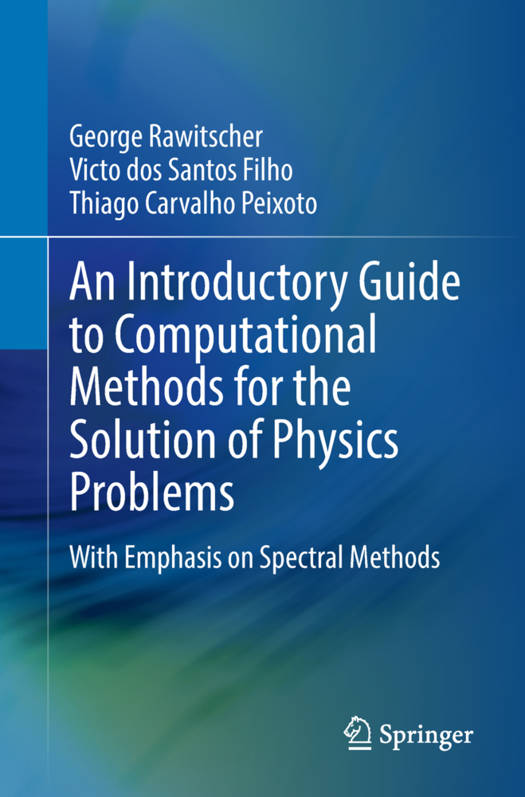
An Introductory Guide to Computational Methods for the Solution of Physics Problems
With Emphasis on Spectral Methods
George Rawitscher, Victo Dos Santos Filho, Thiago Carvalho Peixoto
€ 54,45
+ 108 punten
Eenvoudig bestellen
Veilig betalen


Gratis thuislevering vanaf € 30 (via bpost)
Gratis levering in je Standaard Boekhandel
Omschrijving
This monograph presents fundamental aspects of modern spectral and other computational methods, which are not generally taught in traditional courses. It emphasizes concepts as errors, convergence, stability, order and efficiency applied to the solution of physical problems. The spectral methods consist in expanding the function to be calculated into a set of appropriate basis functions (generally orthogonal polynomials) and the respective expansion coefficients are obtained via collocation equations. The main advantage of these methods is that they simultaneously take into account all available information, rather only the information available at a limited number of mesh points. They require more complicated matrix equations than those obtained in finite difference methods. However, the elegance, speed, and accuracy of the spectral methods more than compensates for anysuch drawbacks.
During the course of the monograph, the authors examine the usually rapid convergence of the spectral expansions and the improved accuracy that results when nonequispaced support points are used, in contrast to the equispaced points used in finite difference methods. In particular, they demonstrate the enhanced accuracy obtained in the solutionof integral equations.
The monograph includes an informative introduction to old and new computational methods with numerous practical examples, while at the same time pointing out the errors that each of the available algorithms introduces into the specific solution. It is a valuable resource for undergraduate students as an introduction to the field and for graduate students wishing to compare the available computational methods. In addition, the work develops the criteria required for students to select the most suitable method to solve the particular scientific problem that they are confronting.
During the course of the monograph, the authors examine the usually rapid convergence of the spectral expansions and the improved accuracy that results when nonequispaced support points are used, in contrast to the equispaced points used in finite difference methods. In particular, they demonstrate the enhanced accuracy obtained in the solutionof integral equations.
The monograph includes an informative introduction to old and new computational methods with numerous practical examples, while at the same time pointing out the errors that each of the available algorithms introduces into the specific solution. It is a valuable resource for undergraduate students as an introduction to the field and for graduate students wishing to compare the available computational methods. In addition, the work develops the criteria required for students to select the most suitable method to solve the particular scientific problem that they are confronting.
Specificaties
Betrokkenen
- Auteur(s):
- Uitgeverij:
Inhoud
- Aantal bladzijden:
- 221
- Taal:
- Engels
- Reeks:
- Reeksnummer:
- nr. 955
Eigenschappen
- Productcode (EAN):
- 9783319427027
- Verschijningsdatum:
- 25/10/2018
- Uitvoering:
- Paperback
- Formaat:
- Trade paperback (VS)
- Afmetingen:
- 156 mm x 234 mm
- Gewicht:
- 340 g


Alleen bij Standaard Boekhandel
+ 108 punten op je klantenkaart van Standaard Boekhandel
CADEAU

AANGERADEN


Beoordelingen
We publiceren alleen reviews die voldoen aan de voorwaarden voor reviews. Bekijk onze voorwaarden voor reviews.