


- Afhalen na 1 uur in een winkel met voorraad
- Gratis thuislevering in België vanaf € 30
- Ruim aanbod met 7 miljoen producten
- Afhalen na 1 uur in een winkel met voorraad
- Gratis thuislevering in België vanaf € 30
- Ruim aanbod met 7 miljoen producten





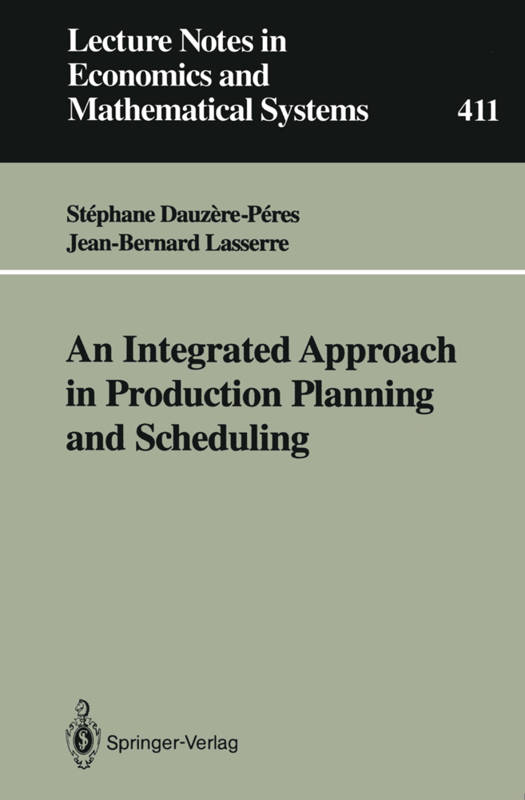
An Integrated Approach in Production Planning and Scheduling
Stephane Dauzere-Peres, Jean-Bernard Lasserre
€ 53,45
+ 106 punten
Omschrijving
Production Management is a large field concerned with all the aspects related to production, from the very bottom decisions at the machine level, to the top-level strategic decisicns. In this book, we are concerned with production planning and scheduling aspects. Traditional production planning methodologies are based on a now widely ac- cepted hierarchical decom?osition into several planning decision levels. The higher in the hierarchy, the more aggregate are the models and the more important are the decisions. In this book, we only consider the last two decision levels in the hierarchy, namely, the mid-term (or tacticaQ planning level and the short-term (or operationaQ scheduling level. In the literature and in practice, the decisions are taken in sequence and in a top-down approach from the highest level in the hierarchy to the bottom level. The decisions taken at some level in the hierarchy are constrained by those already taken at upper levels and in turn, must translate into feasible objectives for the next lower levels in the hierarchy. It is a common sense remark to say that the whole hierarchical decision process is coherent if the interactions between different levels in the hierarchy are taken into account so that a decision taken at some level in the hierarchy translates into a feasible objective for the next decision level in the hierarchy. However, and surpris- ingly enough, this crucial consistency issue is rarely investigated and few results are available in the literature.
Specificaties
Betrokkenen
- Auteur(s):
- Uitgeverij:
Inhoud
- Aantal bladzijden:
- 137
- Taal:
- Engels
- Reeks:
- Reeksnummer:
- nr. 411
Eigenschappen
- Productcode (EAN):
- 9783540579052
- Verschijningsdatum:
- 27/05/1994
- Eerder verschenen als:
- Uitvoering:
- Paperback
- Formaat:
- Trade paperback (VS)
- Afmetingen:
- 156 mm x 234 mm
- Gewicht:
- 240 g


Alleen bij Standaard Boekhandel
+ 106 punten op je klantenkaart van Standaard Boekhandel
Cadeau

AANGERADEN


Beoordelingen
We publiceren alleen reviews die voldoen aan de voorwaarden voor reviews. Bekijk onze voorwaarden voor reviews.