


- Afhalen na 1 uur in een winkel met voorraad
- Gratis thuislevering in België vanaf € 30
- Ruim aanbod met 7 miljoen producten
- Afhalen na 1 uur in een winkel met voorraad
- Gratis thuislevering in België vanaf € 30
- Ruim aanbod met 7 miljoen producten





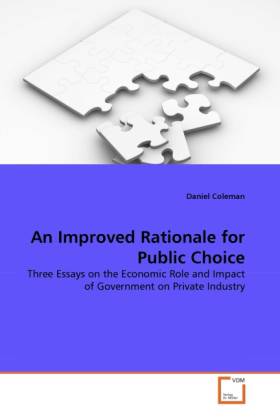
An Improved Rationale for Public Choice
Three Essays on the Economic Role and Impact of Government on Private Industry
Daniel Coleman
Paperback | Engels
€ 93,45
+ 186 punten
Omschrijving
One could argue, the potential for government to have a positive impact on the economy, has been widely accepted as a given, by mainstream economists and United States policy makers. While the cost of government is typically addressed in terms of budgets, taxes and expenditures, Coleman uses a survey of economic theory, empirical studies and governmental reports, in order to offer an improved rationale when assessing the efficacy of existing and potential public initiatives. Inspired by Austrian economists, Coleman identifies and then applies notion of a Production Deficit to each of the productive economic resources, for the purpose of developing a complete accounting of the cost of public initiatives. Delineating Production Deficit from crowding out, opportunity cost and resource displacement, this manuscript culminates in the Minimally Acceptable Production Recovery (MAPR) and Public Efficiency Contribution (PEC) models. These models are intended to serve as decision making tools for those who may be considering the reallocation of private industry resources for public use.
Specificaties
Betrokkenen
- Auteur(s):
- Uitgeverij:
Inhoud
- Aantal bladzijden:
- 164
- Taal:
- Engels
Eigenschappen
- Productcode (EAN):
- 9783639337877
- Verschijningsdatum:
- 3/03/2011
- Uitvoering:
- Paperback
- Afmetingen:
- 152 mm x 229 mm
- Gewicht:
- 249 g


Alleen bij Standaard Boekhandel
+ 186 punten op je klantenkaart van Standaard Boekhandel
AANGERADEN


Beoordelingen
We publiceren alleen reviews die voldoen aan de voorwaarden voor reviews. Bekijk onze voorwaarden voor reviews.