


- Afhalen na 1 uur in een winkel met voorraad
- Gratis thuislevering in België vanaf € 30
- Ruim aanbod met 7 miljoen producten
- Afhalen na 1 uur in een winkel met voorraad
- Gratis thuislevering in België vanaf € 30
- Ruim aanbod met 7 miljoen producten





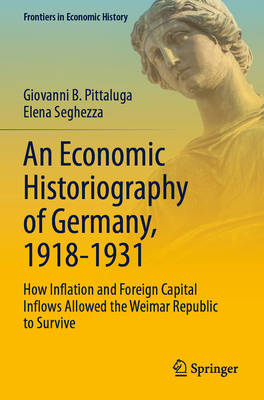
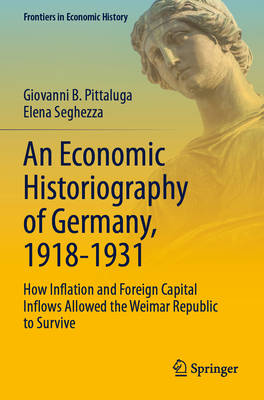
An Economic Historiography of Germany, 1918-1931
How Inflation and Foreign Capital Inflows Allowed the Weimar Republic to Survive
Giovanni B Pittaluga, Elena Seghezza
€ 128,45
+ 256 punten
Uitvoering
Omschrijving
Contrary to existing economic analyses of the Weimar Republic, this book looks beyond the explanations of the individual events that characterized it - in particular hyperinflation, Brüning's fiscal policy, and the 1931 crisis. Instead, it adopts a more unified approach, and thereby sheds light on the underlying causes of these events.
The book argues that these individual events were the final result of economic processes and policy choices which had made it possible to mitigate the social and political conflict that would otherwise have undermined the Republic's existence. Specifically, it postulates that hyperinflation was the result of the "persistent" inflation, which had permitted Germany to maintain low unemployment, meet unions' wage demands, and contain left-wing radicalism.
Similarly, the banking and currency crisis of 1931 was caused by a sudden stop related to the high level of foreign debt incurred by Germany after the Dawes Plan. Debt which had, however, enabled the country to finance the persistent external deficits resulting from its high domestic demand and large public expenditure incurred in an attempt to avoid social conflict.
The book reviews the various models and approaches proposed highlighting their relative strengths and weakness and concludes by providing a unifying common thread which explains how the dramatic economic events which characterized the Weimar Republic were the result of the very economic processes which had contributed to its temporary survival.
This book will appeal to students, scholars, economic researchers in general, and more specifically to those interested in economic history, monetary and financial economics, economic policy, political decision making, and political economy, in particular, those seeking a better understanding of the Weimar Republic's economic history.
Specificaties
Betrokkenen
- Auteur(s):
- Uitgeverij:
Inhoud
- Aantal bladzijden:
- 261
- Taal:
- Engels
- Reeks:
Eigenschappen
- Productcode (EAN):
- 9783031703492
- Verschijningsdatum:
- 10/12/2025
- Uitvoering:
- Paperback
- Formaat:
- Trade paperback (VS)
- Afmetingen:
- 155 mm x 235 mm


Alleen bij Standaard Boekhandel
+ 256 punten op je klantenkaart van Standaard Boekhandel
CADEAU

AANGERADEN


Beoordelingen
We publiceren alleen reviews die voldoen aan de voorwaarden voor reviews. Bekijk onze voorwaarden voor reviews.