


- Afhalen na 1 uur in een winkel met voorraad
- Gratis thuislevering in België vanaf € 30
- Ruim aanbod met 7 miljoen producten
- Afhalen na 1 uur in een winkel met voorraad
- Gratis thuislevering in België vanaf € 30
- Ruim aanbod met 7 miljoen producten





Omschrijving
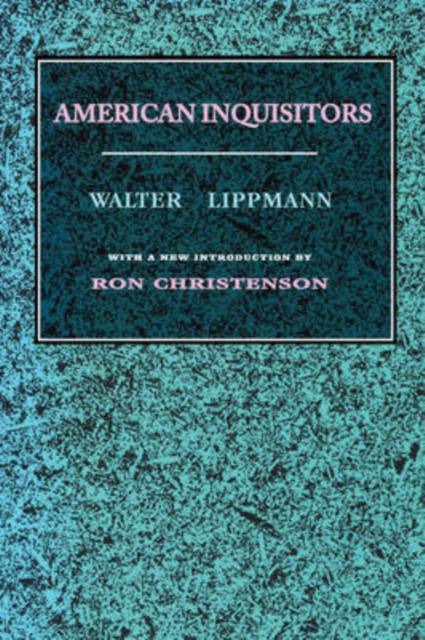
American Inquisitors is one of the small gems among Walter Lippmann's larger books. Written in response to the trials of John Scopes and William McAndrew in 1925 and 1927, this volume contains a succinct analysis of a basic problem of democracy: the conflict between intellectual freedom and majority rule. In both cases, the state, acting in the name of popular sovereignty, sought to suppress teaching that was contrary to the tenets of religious fundamentalism and patriotic tradition. In distilling the arguments surrounding both trials, Lippmann sounds a warning against the tyranny of the majority and challenges people to rethink their theories of liberty and democracy.American Inquisitors consists of five related dialogues, each exploring a different dilemma at the heart of democratic political theory. The first two establish the principles of majority rule and freedom of the mind in the persons of William Jennings Bryan and Thomas Jefferson, with Socrates urging a reexamination of all principles..These dialogues debate the will and the rational capacity of the people to rule and demonstrate the relative nature of freedom in democratic society.The third and fourth dialogues set a fundamentalist against a modernist and an Americanist against a scholar. Lippmann resists easy stereotyping and puts challenging insights and plausible arguments into the mouths of all the parties. These dialogues ask whether commitment to community comes before intellectual inquiry, 'or whether the search for truth precedes identity. The final dialogue, between Socrates and a conscientious teacher, attempts to define the mission of teaching and determine when and how to face the consequences of truth. Lippmann concludes that the program of liberty is to deprive the sovereign of absolute and arbitrary rule. Taken as a whole, the dialogues constitute an essential consistency within Lippmann's political thought, and delineate a recurring problem hi American politcal culture. American Inquisitors will be of special interest to political scientists, historians, sociologists, and American studies specialists.
Specificaties
Betrokkenen
- Auteur(s):
- Uitgeverij:
Inhoud
- Aantal bladzijden:
- 156
- Taal:
- Engels
Eigenschappen
- Productcode (EAN):
- 9781560006350
- Verschijningsdatum:
- 30/01/1993
- Uitvoering:
- Paperback
- Formaat:
- Trade paperback (VS)
- Afmetingen:
- 153 mm x 227 mm
- Gewicht:
- 254 g



Alleen bij Standaard Boekhandel
+ 207 punten op je klantenkaart van Standaard Boekhandel
Cadeau

AANGERADEN


Beoordelingen
We publiceren alleen reviews die voldoen aan de voorwaarden voor reviews. Bekijk onze voorwaarden voor reviews.