


- Afhalen na 1 uur in een winkel met voorraad
- Gratis thuislevering in België vanaf € 30
- Ruim aanbod met 7 miljoen producten
- Afhalen na 1 uur in een winkel met voorraad
- Gratis thuislevering in België vanaf € 30
- Ruim aanbod met 7 miljoen producten





€ 44,45
+ 88 punten
Omschrijving
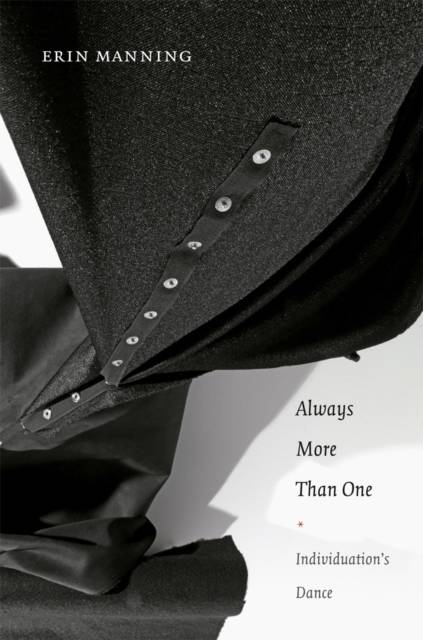
In Always More Than One, the philosopher, visual artist, and dancer Erin Manning explores the concept of the "more than human" in the context of movement, perception, and experience. Working from Whitehead's process philosophy and Simondon's theory of individuation, she extends the concepts of movement and relation developed in her earlier work toward the notion of "choreographic thinking." Here, she uses choreographic thinking to explore a mode of perception prior to the settling of experience into established categories. Manning connects this to the concept of "autistic perception," described by autistics as the awareness of a relational field prior to the so-called neurotypical tendency to "chunk" experience into predetermined subjects and objects. Autistics explain that, rather than immediately distinguishing objects-such as chairs and tables and humans-from one another on entering a given environment, they experience the environment as gradually taking form. Manning maintains that this mode of awareness underlies all perception. What we perceive is never first a subject or an object, but an ecology. From this vantage point, she proposes that we consider an ecological politics where movement and relation take precedence over predefined categories, such as the neurotypical and the neurodiverse, or the human and the nonhuman. What would it mean to embrace an ecological politics of collective individuation?
Specificaties
Betrokkenen
- Auteur(s):
- Uitgeverij:
Inhoud
- Aantal bladzijden:
- 328
- Taal:
- Engels
Eigenschappen
- Productcode (EAN):
- 9780822353348
- Verschijningsdatum:
- 9/01/2013
- Uitvoering:
- Paperback
- Formaat:
- Trade paperback (VS)
- Afmetingen:
- 152 mm x 234 mm
- Gewicht:
- 408 g



Alleen bij Standaard Boekhandel
+ 88 punten op je klantenkaart van Standaard Boekhandel
Cadeau

AANGERADEN


Beoordelingen
We publiceren alleen reviews die voldoen aan de voorwaarden voor reviews. Bekijk onze voorwaarden voor reviews.