



Je cadeautjes zeker op tijd in huis hebben voor de feestdagen? Kom langs in onze winkels en vind het perfecte geschenk!
- Afhalen na 1 uur in een winkel met voorraad
- Gratis thuislevering in België vanaf € 30
- Ruim aanbod met 7 miljoen producten
Je cadeautjes zeker op tijd in huis hebben voor de feestdagen? Kom langs in onze winkels en vind het perfecte geschenk!
- Afhalen na 1 uur in een winkel met voorraad
- Gratis thuislevering in België vanaf € 30
- Ruim aanbod met 7 miljoen producten





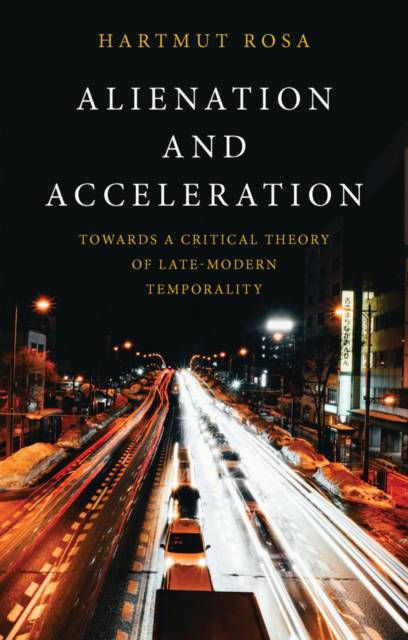
Alienation and Acceleration
Towards a Critical Theory of Late-Modern Temporality
Hartmut Rosa
Paperback | Engels
€ 25,95
+ 51 punten
Uitvoering
Omschrijving
Modern life is speeding-up, constantly. While the art of saving time reaches unprecedented heights through the introduction of ever-new technologies of communication and production, it nevertheless feels like we are running out of time. In all western societies, time scarcity is increasing and individuals report the impression of having to run faster and faster every year - not in order to get somewhere, but just to stay where they are. In this short book Hartmut Rosa outlines his theory of social acceleration and uses it to analyse the causes and consequences of the temporal processes that characterize modern societies. He shows that modern temporal structures are governed by the logic of an acceleration process that defines the essence of modernity. He also develops a critical theory of social acceleration, arguing that acceleration leads to severe forms of alienation from time and space, from things and actions and from self and others, thus constituting a key obstacle to the realization of a 'good life' in late-modern society. Modern life is speeding-up, constantly. While the art of saving time reaches unprecedented heights through the introduction of ever-new technologies of communication and production, it nevertheless feels like we are running out of time. In all western societies, time scarcity is increasing and individuals report the impression of having to run faster and faster every year - not in order to get somewhere, but just to stay where they are. In this short book Hartmut Rosa outlines his theory of social acceleration and uses it to analyse the causes and consequences of the temporal processes that characterize modern societies. He shows that modern temporal structures are governed by the logic of an acceleration process that defines the essence of modernity. He also develops a critical theory of social acceleration, arguing that acceleration leads to severe forms of alienation from time and space, from things and actions and from self and others, thus constituting a key obstacle to the realization of a 'good life' in late-modern society.
Specificaties
Betrokkenen
- Auteur(s):
- Uitgeverij:
Inhoud
- Aantal bladzijden:
- 110
- Taal:
- Engels
Eigenschappen
- Productcode (EAN):
- 9781509572076
- Verschijningsdatum:
- 26/05/2026
- Uitvoering:
- Paperback
- Formaat:
- Trade paperback (VS)


Alleen bij Standaard Boekhandel
+ 51 punten op je klantenkaart van Standaard Boekhandel
CADEAU


Beoordelingen
We publiceren alleen reviews die voldoen aan de voorwaarden voor reviews. Bekijk onze voorwaarden voor reviews.