


- Afhalen na 1 uur in een winkel met voorraad
- Gratis thuislevering in België vanaf € 30
- Ruim aanbod met 7 miljoen producten
- Afhalen na 1 uur in een winkel met voorraad
- Gratis thuislevering in België vanaf € 30
- Ruim aanbod met 7 miljoen producten





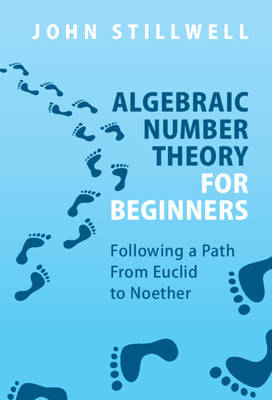
Algebraic Number Theory for Beginners
Following a Path from Euclid to Noether
John Stillwell
Hardcover | Engels
€ 160,45
+ 320 punten
Uitvoering
Omschrijving
This book introduces algebraic number theory through the problem of generalizing 'unique prime factorization' from ordinary integers to more general domains. Solving polynomial equations in integers leads naturally to these domains, but unique prime factorization may be lost in the process. To restore it, we need Dedekind's concept of ideals. However, one still needs the supporting concepts of algebraic number field and algebraic integer, and the supporting theory of rings, vector spaces, and modules. It was left to Emmy Noether to encapsulate the properties of rings that make unique prime factorization possible, in what we now call Dedekind rings. The book develops the theory of these concepts, following their history, motivating each conceptual step by pointing to its origins, and focusing on the goal of unique prime factorization with a minimum of distraction or prerequisites. This makes a self-contained easy-to-read book, short enough for a one-semester course.
Specificaties
Betrokkenen
- Auteur(s):
- Uitgeverij:
Inhoud
- Aantal bladzijden:
- 242
- Taal:
- Engels
Eigenschappen
- Productcode (EAN):
- 9781316518953
- Verschijningsdatum:
- 11/08/2022
- Uitvoering:
- Hardcover
- Formaat:
- Genaaid
- Afmetingen:
- 152 mm x 229 mm
- Gewicht:
- 494 g


Alleen bij Standaard Boekhandel
+ 320 punten op je klantenkaart van Standaard Boekhandel
Cadeau

AANGERADEN


Beoordelingen
We publiceren alleen reviews die voldoen aan de voorwaarden voor reviews. Bekijk onze voorwaarden voor reviews.