


- Afhalen na 1 uur in een winkel met voorraad
- Gratis thuislevering in België vanaf € 30
- Ruim aanbod met 7 miljoen producten
- Afhalen na 1 uur in een winkel met voorraad
- Gratis thuislevering in België vanaf € 30
- Ruim aanbod met 7 miljoen producten





Omschrijving
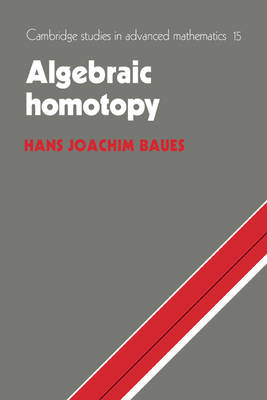
This book gives a general outlook on homotopy theory; fundamental concepts, such as homotopy groups and spectral sequences, are developed from a few axioms and are thus available in a broad variety of contexts. Many examples and applications in topology and algebra are discussed, including an introduction to rational homotopy theory in terms of both differential Lie algebras and De Rham algebras. The author describes powerful tools for homotopy classification problems, particularly for the classification of homotopy types and for the computation of the group homotopy equivalences. Applications and examples of such computations are given, including when the fundamental group is non-trivial. Moreover, the deep connection between the homotopy classification problems and the cohomology theory of small categories is demonstrated. The prerequisites of the book are few: elementary topology and algebra. Consequently, this account will be valuable for non-specialists and experts alike. It is an important supplement to the standard presentations of algebraic topology, homotopy theory, category theory and homological algebra.
Specificaties
Betrokkenen
- Auteur(s):
- Uitgeverij:
Inhoud
- Aantal bladzijden:
- 488
- Taal:
- Engels
- Reeks:
- Reeksnummer:
- nr. 15
Eigenschappen
- Productcode (EAN):
- 9780521333764
- Verschijningsdatum:
- 16/02/1989
- Uitvoering:
- Hardcover
- Formaat:
- Genaaid
- Afmetingen:
- 152 mm x 229 mm
- Gewicht:
- 884 g


Alleen bij Standaard Boekhandel
+ 550 punten op je klantenkaart van Standaard Boekhandel
Wedstrijd


Beoordelingen
We publiceren alleen reviews die voldoen aan de voorwaarden voor reviews. Bekijk onze voorwaarden voor reviews.